


Pink gemstones include rose quartz, morganite, pink sapphire, tourmaline, spinel, kunzite, and several opaque or patterned stones. Their color can be almost white, peachy, raspberry, or close to purple. To choose between them, look beyond the shade: transparency, markings, treatments, and the way you plan to wear the stone all matter.
For a bracelet, pink can be a small detail rather than the main color. Rhodonite Bracelet combines polished rhodonite beads with darker markings and an adjustable cord, giving a practical example of pink in men's jewelry.

RHODONITE BRACELET
You can also compare the wider range of stone bracelets to see how different bead colors work together.
Pink gemstones chart: names and visible differences
This chart describes common appearances, not an identification test. Individual stones vary, and several materials can look alike in a photograph.
| Pink gemstone | Look to compare | Useful distinction |
|---|---|---|
| Rose quartz | Cloudy blush to deeper pink | Usually a soft, translucent appearance |
| Morganite | Pale pink to peach-pink | Often transparent when faceted |
| Pink sapphire | Delicate pink through stronger shades | Corundum, with Mohs hardness 9 |
| Pink tourmaline | Pale rose through vivid pink | Can show strong color and visible inclusions |
| Pink spinel | Pale to vivid pink | A separate mineral from sapphire |
| Kunzite | Pink to violet-pink | Needs protection from blows, heat, and intense light |
| Rhodolite garnet | Raspberry pink to purplish red | Different from rhodonite despite the similar name |
| Pink opal | Opaque or slightly translucent pink | Common opal does not show rainbow play-of-color |
| Rhodonite | Pink with dark veins or patches | Often used as polished beads |
| Rhodochrosite | Pink with pale bands | A different mineral from rhodonite |
| Pink diamond | Faint pink through stronger color grades | Natural color and laboratory origin need clarification |
| Pink chalcedony | A smooth, translucent pink appearance | Ask whether the color has been enhanced |
12 pink gemstones worth knowing
1. Rose quartz
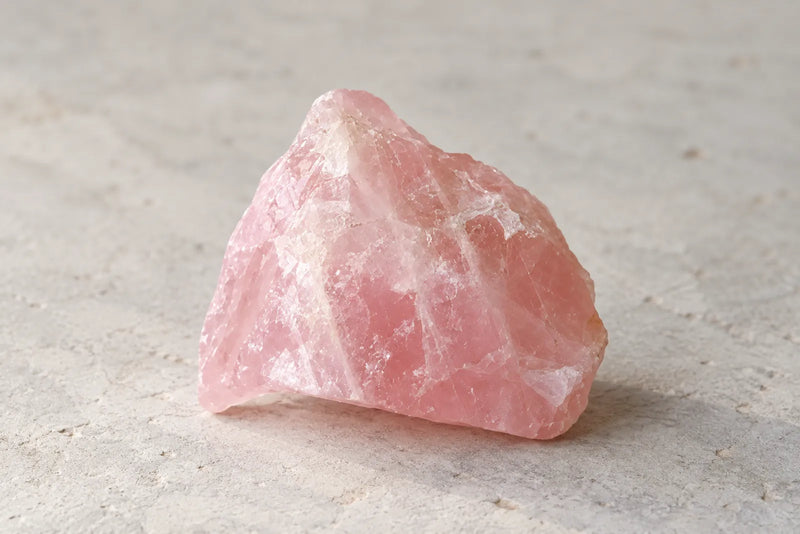
Rose quartz is a familiar light pink gemstone, with a cloudy translucence that makes it look softer than a clear, faceted stone. Its color can range from almost white to medium-dark pink.
Small pieces may look much paler than a large specimen. When comparing beads, judge the actual strand or finished bracelet rather than expecting the color of a large display stone.
2. Morganite

Morganite is the pink to orange-pink variety of beryl. Faceted examples often have a clear appearance, with shades that lean toward blush, salmon, or peach.
That warmth is useful to notice. If you want a cool pink, a peachy morganite may look quite different from what you had in mind. Ask for photographs in neutral light rather than relying on a warm studio image.
3. Pink sapphire

Pink sapphire belongs to the corundum family. Its Mohs hardness is 9, making it highly resistant to scratching, although no gemstone is immune to damage.
The name covers a range of pinks. Padparadscha refers to a particular pinkish-orange sapphire color, so it should not be used as a general label for every peach or pink sapphire. Ask how a seller supports that description.
4. Pink tourmaline

Pink tourmaline can be pale and delicate or much more saturated. Some pink-to-red examples have visible inclusions, which means two stones of similar color can differ in clarity.
It is worth comparing the whole stone rather than color alone. Look at whether it has an even appearance, whether areas look darker, and how the cut presents the color. None of those observations confirms identity on its own.
5. Pink spinel

Spinel is its own mineral, even when its color resembles sapphire or ruby. Pink examples can be vivid, and a well-cut stone can show considerable brilliance.
With a Mohs hardness of 8, it has good scratch resistance. For a ring or another exposed piece, the setting and the condition of the individual stone still matter. A hardness number should help a comparison, not replace it.
6. Kunzite

Kunzite is a variety of spodumene with pink to violetish-purple color. It can have the pale, clear appearance people are looking for when they search for a light pink crystal.
Its care requirements deserve attention. Kunzite can split along cleavage directions, and prolonged heat or intense light can fade its color. A protected pendant is a more forgiving use than jewelry that regularly takes knocks.
7. Rhodolite garnet
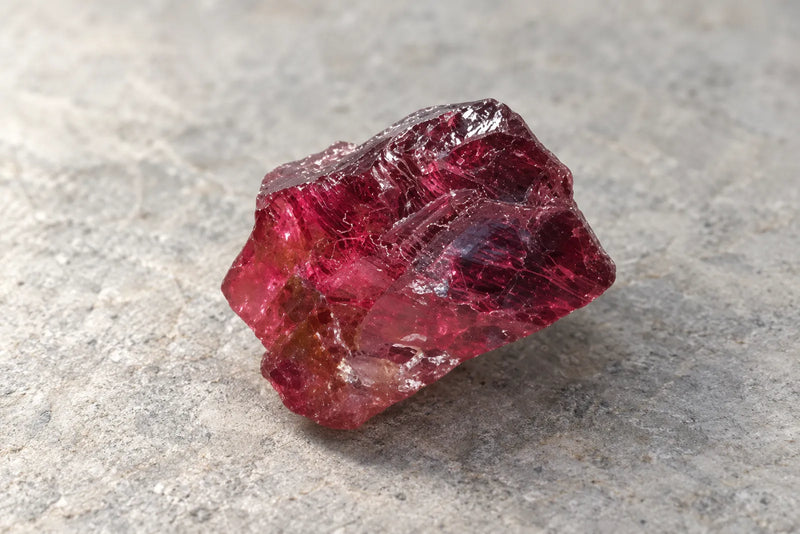
Rhodolite garnet brings raspberry, pink-purple, and purplish-red shades into the comparison. It is a garnet variety intermediate in composition between pyrope and almandine.
The name is easy to confuse with rhodonite or rhodochrosite, but these are different materials. Rhodolite is the one to investigate when you want a faceted garnet with a berry-colored appearance rather than a patterned pink bead.
8. Pink opal

Pink opal usually has an opaque or slightly translucent appearance. It belongs to common opal, which does not display the shifting rainbow flashes known as play-of-color.
A quiet, even pink surface is therefore not a flaw simply because it lacks those flashes. Compare the body color and visible markings. A listing that promises both uniform opaque pink and dramatic rainbow effects needs a closer explanation.
9. Rhodonite

Rhodonite often combines a pink body with dark markings. The massive material is used for beads and rounded polished stones, while transparent crystals are much less typical of the jewelry most people encounter.
Those dark areas change how pink looks on the wrist. A bead with broad black patches can feel quite different from one that is mostly pink. Our guide explains what gives rhodonite its dark markings.
Rhodonite Bracelet Silver pairs polished pink-and-dark rhodonite beads with silver details and an adjustable cord. It is another way to compare the material in a finished piece, where the metal and cord contribute to the overall color.

RHODONITE BRACELET SILVER
10. Rhodochrosite
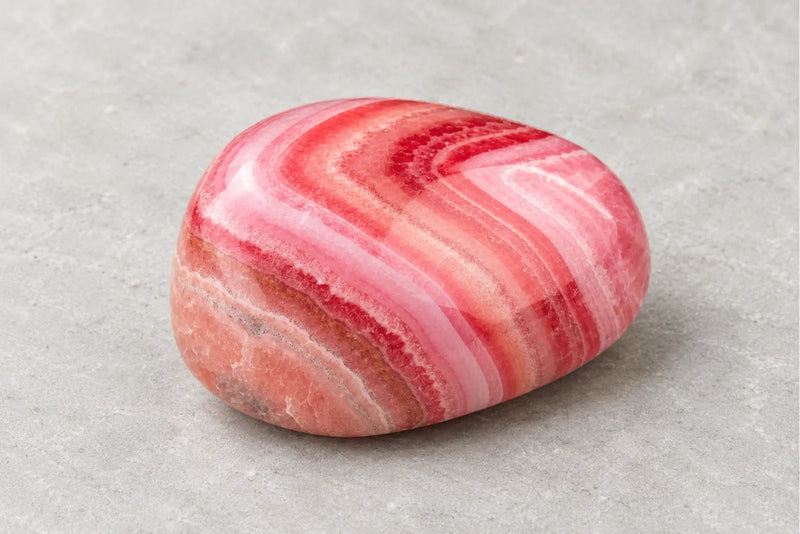
Rhodochrosite is a manganese carbonate, whereas rhodonite is a manganese silicate. Banded material often shows pale pink and whitish layers; rare specimens can form deep red crystals.
The similar names are not interchangeable. When buying, check which material is actually listed, then compare the specific piece. Bands, veins, and color offer clues, but a photograph cannot settle every identification.
11. Pink diamond
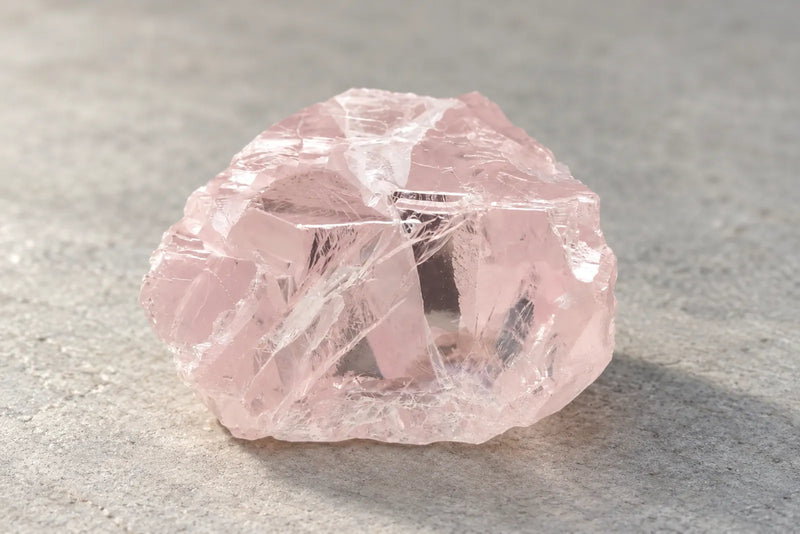
Natural-color pink diamonds are rare and can be highly valuable. Their appearance ranges from faint color to much stronger pink, with grading terminology that differs from a casual description such as blush or hot pink.
Clarify whether a diamond is natural or laboratory-grown and whether its color has been treated. For an expensive purchase, an appropriate independent laboratory report is more useful than an attractive color name.
12. Pink chalcedony

Chalcedony is a fine-grained form of silica, commonly described as microcrystalline quartz. Pink material can offer a smooth, translucent look without the sparkling facets of a clear sapphire or spinel.
Color disclosure matters here because chalcedony can be dyed. A natural stone can still have an enhanced color. Ask about treatment rather than assuming that the word natural means the pink itself is untreated.
Light pink, hot pink, or patterned: how to narrow the choice
Start with the effect you want. Rose quartz gives a cloudy blush; morganite can offer a clearer, peachier pink; kunzite can lean toward lilac. These are different appearances even when all three are described as pale pink.
For stronger color, compare individual pink tourmalines, sapphires, and spinels. Rhodolite may suit you if you prefer a berry shade, especially where pink gives way to red. If the purple undertone interests you more, compare stones with more violet in the color.
For pattern, look closely at rhodonite and rhodochrosite. You may also encounter the trade name pink zebra jasper. Read the material description carefully rather than treating every pink trade name as a separate mineral species.
Wearing pink stones in men's jewelry
A small amount of pink is easy to try with clothes you already own. A patterned bead bracelet beside navy, gray, or olive gives you a different result from a clear pink stone in a polished metal setting. Neither needs a matching pink shirt.
If you prefer a layered look, Mallorca Bracelet Set combines rhodonite, white howlite, clay beads, a nautical-cord friendship bracelet, and a bangle. It shows how pink can sit within a mixed palette rather than dominate the whole stack.

MALLORCA BRACELET SET
For a single piece, compare bead size, the amount of dark patterning, and the metal around it. For a stack, give each bracelet enough space to be seen. Trying fewer pieces first makes it easier to decide whether you want more color or simply a different texture.
What to ask before buying a pink gemstone
Begin with three questions: What is the material? Has it been treated? What care does the finished piece need?
Natural, laboratory-grown, and imitation describe different things. A laboratory-grown gemstone has essentially the same chemical, physical, and optical properties as its natural counterpart. An imitation is another material chosen to resemble it. A natural gem may also have been heated, dyed, coated, or otherwise treated.
GIA explains how treatments can change a gem, including why treatments can affect care. A disclosure is useful information for choosing and maintaining the piece.
Ask for the dimensions of the actual stone or beads and photographs under neutral lighting. If the listing uses a broad name such as pink stone, request a more specific identification. For a costly gem, ask what an independent report confirms about identity, origin type, and color treatment.
Price comparisons need the same care. Size, color, clarity, treatment, and the distinction between a loose stone and finished jewelry can change what you are comparing. A single price range for all pink gemstones tells you very little.
Caring for the whole piece
Hardness describes resistance to scratching. Toughness concerns resistance to breaking, and stability concerns reactions to conditions such as heat, light, or chemicals. Kunzite illustrates why these are separate questions: a respectable hardness number does not prevent cleavage or color fading.
For a bracelet, consider the cord, metal, and any other beads as well as the pink stone. Follow the maker's instructions for the complete piece. Our advice on care for a bracelet with mixed materials is a useful place to start.
For the Maresi examples here, remove the bracelets before swimming, showering, or exercising and wipe them with a soft, dry cloth. Avoid choosing a cleaner solely because it is suitable for one of the materials.
FAQs about pink gemstones
Is every pink crystal rose quartz?
No. Pink crystals can belong to several different minerals, including tourmaline, spodumene, and beryl. Color alone is not enough to identify them.
Are pink pearls gemstones?
Pearls are organic gems produced by mollusks, rather than mineral crystals mined from rock. A pink-pearl listing should also explain whether its color is natural or treated.
Which birthstones can be pink?
Sapphire, spinel, tourmaline, and opal can occur in pink. Their birthstone months are September, August, October, and October respectively. The month belongs to the gem type, not exclusively to its pink variety.
Does a more expensive pink stone look better in a bracelet?
That depends on the look you want. A clear faceted gem and an opaque patterned bead do different jobs visually. Compare the actual piece, its construction, and the care it needs rather than using price as a substitute for preference.

Save 20%
Coordinated pieces, ready to wear.

Up to 15%
Pick any 3 or 5 bracelets.
From a customer
★★★★★
“Still wearing it two months later.”
Nick Verified · Sicily set


