

Millefiori glass is glass decorated with cross-sections of patterned canes, often arranged to resemble a field of small flowers. The maker builds a design through the length of a glass cane, draws the cane thinner, cuts it into patterned slices called murrine, and fuses those pieces into or onto another glass form.
You can see the technique at wearable scale in the Millefiori glass bracelet, where each millefiori bead reveals a slightly different mix of miniature patterns.
The Paros Picasso Seed Bracelet gives you another kind of patterned glass to compare. Its Picasso finish changes the surface of the seed beads, while a millefiori pattern comes from a slice of patterned cane.

PAROS PICASSO SEED BRACELET
What does millefiori mean?
Millefiori comes from the Italian words mille, meaning “thousand,” and fiori, meaning “flowers.” The name describes the effect rather than a single recipe. Look closely at a finished piece and you may see dozens of small stars, rings, rosettes, eyes, or flower-like forms packed across the surface.
The usual English pronunciation is roughly mil-leh-fee-OR-ee. Although flowers inspired the name, not every cane has a floral design. Geometric and star-shaped patterns belong comfortably within the same visual language.
How is millefiori glass made?
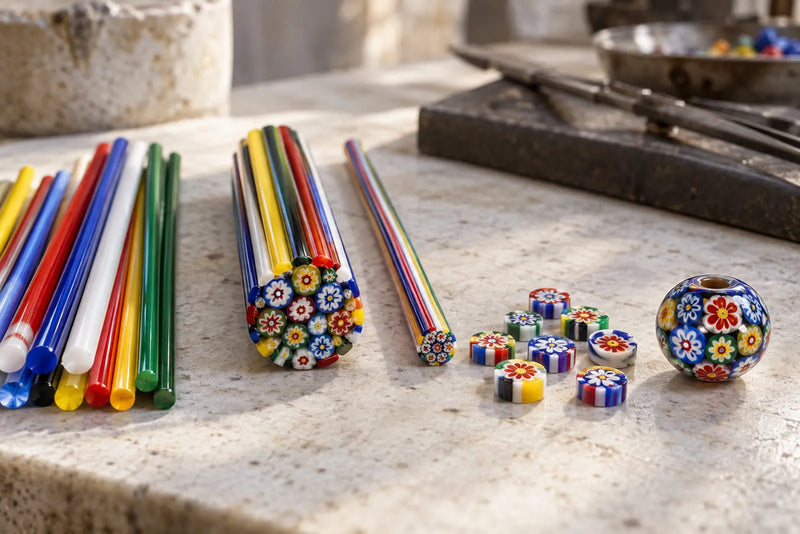
The exact workshop method varies with the object, the furnace, and the maker. The core idea, however, is consistent: a pattern is constructed inside a cane so that every crosswise cut reveals a related design. A simplified process looks like this:
- Build the pattern. The glassmaker gathers or assembles differently colored rods and layers of hot glass around a center. Their arrangement determines the eventual cross-section. A star mold may shape a layer into points, while additional colors create rings, petals, or outlines.
- Fuse the bundle. The assembled glass is heated until the parts join. Temperature control matters. The glass must be soft enough to bond and stretch without allowing the internal pattern to collapse into a blur.
- Draw the cane. While hot, the bundle is pulled into a long, narrow cane. Pulling reduces the design dramatically, but the same basic image continues through the cane from end to end, much like a pattern running through a roll of candy.
- Cool and cut it. Once annealed and cooled, the cane is sliced crosswise. These small patterned sections are commonly called murrine. Their thickness depends on how they will be used.
- Arrange the slices. The murrine may be laid in a mold, placed on a heated surface, picked up around a gather of molten glass, or applied to a bead. This stage controls the spacing, color rhythm, and density of the finished design.
- Fuse and shape the object. Heat softens the slices and the surrounding glass so they unite. The maker can then roll, press, blow, or lampwork the material into a bead, vessel, paperweight, pendant, or another form.
- Anneal and finish. Slow, controlled cooling relieves internal stress. Depending on the object, the surface may then be ground, polished, drilled, or fire-polished.
This is why millefiori is more than a painted surface. The motif begins as part of the glass itself. Cutting the cane exposes the design; fusing and shaping carry it into the finished object.
Millefiori versus murrine
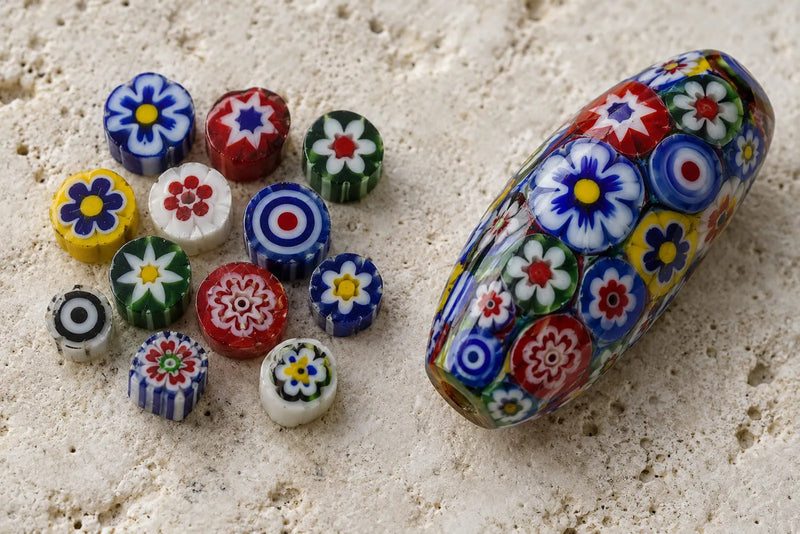
The two terms are closely related, but they are not perfect synonyms. Murrine are the patterned cross-sections cut from a glass cane, or the decorative elements made from those sections. Millefiori usually describes the flower-field effect or the broader decorative technique created by arranging and fusing many such pieces.
Usage is not completely uniform. Museum glossaries note that glassmakers, collectors, and writers sometimes apply murrina, murrine, mosaic glass, and millefiori differently. For a clear practical distinction, think of murrine as the patterned ingredients and millefiori as the recognizable decoration they can create.
[[featured_products]
The Millefiori Bracelet Silver offers a useful visual example of that distinction. The eye first reads a lively overall millefiori pattern, then begins to separate the tiny individual cane sections within each bead. The silver details frame the glass without changing the name of the technique.
Is all millefiori Murano glass?
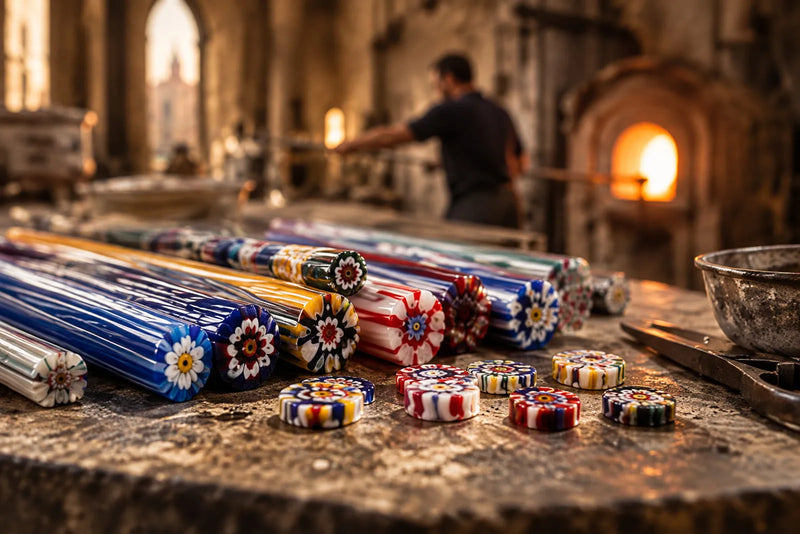
No. Murano is a group of islands in the Venetian Lagoon with a celebrated glassmaking tradition. Millefiori is a decorative glass technique. A skilled maker can practice that technique in Murano, elsewhere in Italy, or in another country entirely.
Murano millefiori glass is an appropriate description when the object is documented as having been made in Murano. Without reliable provenance, a label, a maker’s record, or a trustworthy certificate, the pattern alone does not prove geographic origin. A flower-like cane design tells you how the decoration was created, not necessarily where the object was made.
This distinction also explains why phrases such as “Murano style” should not be read as proof of Murano manufacture. Style, technique, and origin answer three different questions. Honest descriptions keep them separate.
A concise history of millefiori glass
The story does not begin with the modern Italian term. Ancient glassworkers used bundled rods and canes to create mosaic patterns centuries before the word millefiori became common. A Roman-period glass inlay in The Metropolitan Museum of Art, dated broadly from 30 BCE to 364 CE and associated with Egypt, shows how cross-cut cane sections could form a complex repeated image.
For that reason, museums often describe ancient millefiori glass as mosaic glass. The Corning Museum of Glass recommends the broader historical term mosaic glass for objects assembled from preformed patterned elements, reserving millefiori more specifically for Venetian and Venetian-style work. This wording avoids projecting a later Italian label onto every ancient example.
Museum history connects the technique with fifteenth-century Venetian glassmaking. The technique later lost prominence, then returned strongly during the nineteenth-century revival of historic Venetian glass. Murano workshops refined patterned canes and used them in vessels, beads, paperweights, and decorative objects.
The revival was influential, but it was not geographically exclusive. Museum collections document nineteenth-century French millefiori paperweights, and glass artists around the world continue to work with patterned cane today. Murano remains central to the tradition, not the boundary of the technique.
How millefiori glass becomes beads
Beadmakers can incorporate murrine in several ways. One familiar method begins with a hot core of glass formed around a metal mandrel. Small cane slices are placed against the warm surface, reheated, and gently pressed or rolled until they fuse with the bead. Clear glass may be added over the pattern to create depth and protect the decoration.
Another approach forms a larger patterned billet or rod that can be cut and finished as individual beads. Whatever the route, the bead must be annealed so it cools evenly. Afterward, the mandrel is removed, the hole is cleaned, and the bead may be polished or lightly fire-finished.
Scale changes the effect. A paperweight can display broad, carefully spaced canes, while a small bead compresses many details into a few millimeters. Our guide to how glass beads work in bracelets explains how bead size, finish, cord, and surrounding materials affect the way glass reads on the wrist.

MILLEFIORI BRACELET SILVER
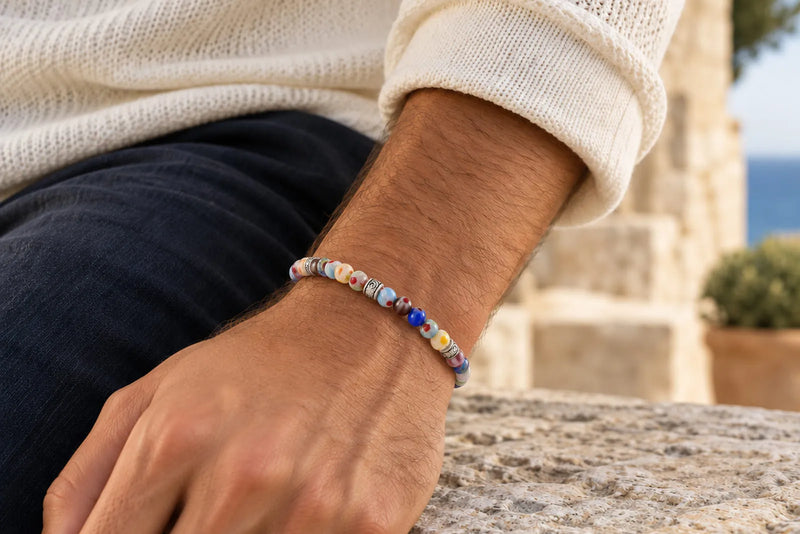
The Millefiori Bracelet makes that individuality visible from bead to bead: related colors and motifs create continuity, while the tiny shifts keep the pattern from looking mechanically repeated.
Where millefiori appears
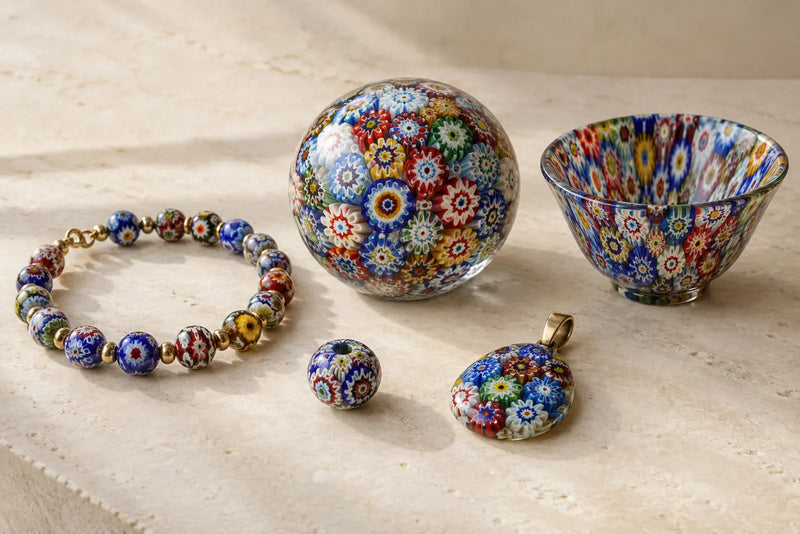
Millefiori is unusually adaptable. In jewelry, patterned glass may appear as round beads, pendants, cabochons, earrings, or flat inlays. Paperweights often use canes as carefully spaced focal points, sometimes arranged in concentric rings or close-packed carpets beneath a clear dome.
Vessels can be covered with dense fields of murrine or use them as controlled accents. Small dishes, bowls, buttons, tiles, boxes, sculpture, and other decorative objects also make use of the technique. The object may be furnace-worked, kiln-fused, lampworked, pressed, or cold-finished after firing.
Why individual patterns vary
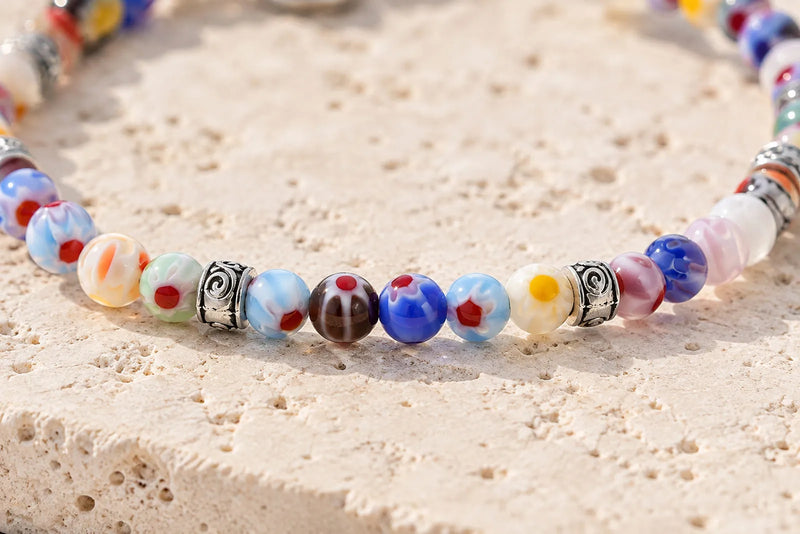
A patterned cane repeats, but it does not behave like a machine-printed image. Slight changes occur as the hot bundle is drawn. One section may stretch more than another, a star may become narrower, or an outer ring may shift. The angle and thickness of each cut also alter what the viewer sees.
Placement adds another layer of variation. During reheating, one murrina may flatten while another remains slightly raised. Curving a decorated sheet around a vessel or bead changes spacing at the edges. Color can appear deeper under clear glass and brighter where it sits near the surface.
Those small differences are part of the material’s character, not automatically defects. They are evidence of how heat, cutting, placement, and shaping affect glass by hand.
The Millefiori Bracelet gives a small-scale example. Compare neighboring beads to see how the shapes and colors of the motifs change.

MILLEFIORI BRACELET
How to care for millefiori glass
Glass is durable in ordinary wear, but it can chip or crack after a hard impact. Put on millefiori jewelry over a soft surface, store pieces separately from harder jewelry, and avoid dropping them onto tile or stone. Keep elastic, cord, adhesives, and metal findings away from prolonged moisture, perfume, household cleaners, and sudden temperature changes.
For routine cleaning, wipe the glass with a soft, slightly damp cloth, then dry it. Avoid abrasives and ultrasonic cleaning unless the maker specifically confirms that every material in the piece can tolerate it. These broader tips for care for glass beads and cord can help protect the complete bracelet, not only its glass surface.
FAQs
What is millefiori glass?
Millefiori glass is decorated with cross-sections cut from patterned glass canes. When many slices are arranged and fused, they can resemble a field of miniature flowers, stars, or rings. The pattern is built into the glass rather than painted onto the finished surface.
What is the difference between millefiori and Murano glass?
Millefiori names a decorative technique or visual effect. Murano identifies a place and its glassmaking tradition. Glass made in Murano may use millefiori, but millefiori can also be produced elsewhere. A patterned surface alone cannot establish that an object was made in Murano.
How is millefiori glass made?
Colored glass rods and layers are assembled into a pattern, heated, and drawn into a long cane. After cooling, the cane is cut crosswise into patterned slices called murrine. Makers arrange and fuse those slices into beads, vessels, paperweights, jewelry components, or other glass objects.
Where is millefiori glass made?
Millefiori has a particularly strong association with Venice and Murano, but makers use the technique in many countries. Historic French paperweights and contemporary studio glass provide clear examples beyond Italy. Origin should be supported by provenance or maker documentation, not inferred from the pattern alone.
Can you identify authentic Murano millefiori glass by sight?
Appearance can help assess technique and quality, but it usually cannot prove Murano origin. Look for a documented maker, retailer records, original labels, or a credible certificate. Treat terms such as “Murano style” or “Venetian style” as descriptions unless the seller provides reliable origin information.
A pattern worth looking at closely
Millefiori rewards a second look. What first appears to be a cheerful scatter of flowers is actually the visible end of a carefully constructed cane, multiplied through cutting, placement, heat, and handwork. Understanding that process makes millefiori jewelry more interesting: every bead carries a compact record of how color and glass were assembled.
-

$20.99 USD
View product -

$11.99 USD
View product -

MULTICOLOR SHAMBALLA CLAY BRACELET
$15.99 USD
View product


Save 20%
Coordinated pieces, ready to wear.

Up to 15%
Pick any 3 or 5 bracelets.
From a customer
★★★★★
“Still wearing it two months later.”
Nick Verified · Sicily set


