


The main types of seed beads include round rocailles, cylinders, bugles, Charlotte-cut beads, hex-cut beads, triangles, cubes, drops, Magatamas, and thin glass spacers. Specialty two-hole beads include SuperDuo and TILA. Their shapes affect how they sit together and how a finished piece looks. Brand, size, and finish describe other characteristics, so two beads labeled 11/0 can still be quite different.
If a bead listing feels like a string of unfamiliar names, start with the shape. Then check its dimensions, material, and finish. That order makes it much easier to choose beads that will work together.
Comparing seed bead bracelets in solid colors and Picasso finishes makes the difference between bead color and surface treatment easier to see.
What are seed beads?
Seed beads are small beads used for stringing, bead weaving, loom work, and embroidery. Many familiar varieties are made of glass. Despite the name, they aren't necessarily made from plant seeds, and they don't all have the same rounded outline.
Their small size can turn individual beads into a continuous line of color. The Loreto Azzuro Seed Bracelet, for example, uses 2 mm red Miyuki glass seed beads on adjustable nautical cord. At that scale, the color and the line of the bracelet are easier to notice than each separate bead.

LORETO AZZURRO DIAMANTI SEED BRACELET
Different types of seed beads at a glance
Some names describe an overall shape; others describe a cut or a named product family. Here's how the common ones compare.
| Bead type | What it looks like | Where it can be useful |
|---|---|---|
| Round or rocaille | Rounded sides, often with a doughnut-like profile | Strung jewelry, weaving, and embroidery |
| Cylinder | Short tube with straighter sides and flatter ends | Flat geometric beadwork and loom designs |
| Bugle | A longer, narrow tube | Fringe, lines, and longer accents |
| Charlotte cut | A rounded bead with small cut facets | Small flashes of reflected light |
| Hex-cut | A six-sided outer profile | Angular texture and reflected light |
| Triangle | A triangular outer profile | Geometric detail and dimensional beadwork |
| Cube or square | A small block-like shape | Straight-edged accents and geometric arrangements |
| Drop | A rounded teardrop-like shape | Fringe, edging, and raised details |
| Magatama | A full, rounded teardrop profile | Dimensional details and textured arrangements |
| Glass spacer | A thin bead with a shallow profile | Separating neighboring beads and adding accents |
| SuperDuo | A shaped, pressed glass bead with two holes | Patterns that use both holes to connect beadwork |
| TILA family | Flat square or rectangular beads with two parallel holes | Tile-like arrangements and two-hole beadwork |
These aren't mutually exclusive categories. Delica is a MIYUKI cylinder bead family, and a cylinder can also have a cut surface. A two-hole tile bead introduces another difference: the way the thread travels through it.

How to recognize the different seed bead shapes
Round seed beads, or rocailles
Round seed beads have curved sides and often a doughnut-like profile. They aren't necessarily perfect spheres.
In a strand or woven design, those rounded edges remain visible between neighboring beads. They're a useful starting point for simple bead stringing, but match the specified bead family when a pattern depends on even spacing.
Cylinder seed beads
Cylinder seed beads are short tubes with straighter walls and flatter ends. They sit closely together, making them useful for tidy rows and geometric patterns.
MIYUKI Delica, TOHO Aiko, and TOHO Treasure are cylinder bead families. Substituting rounds in a cylinder pattern may change its width, spacing, and surface.
Bugle beads
Bugles are longer tubes used for fringe, embroidery, and straight or radiating details.
Read the length as well as the width: a 3 mm bugle and a 6 mm bugle occupy different amounts of space. Inspect the cut ends and follow the pattern's instructions for protecting thread around them.
Charlotte-cut beads
Charlottes are rounded seed beads with small cut facets. A flat face catches the light differently from the curved glass around it, producing little flashes as the bead turns.
They retain a rounded outline, so the effect is subtler than a fully faceted bead. Read the product description for the precise cut.
Hex-cut and other cut beads
Hex-cut beads have a six-sided outer profile. Other cut styles arrange their flat faces differently, giving each style its own angular texture.
A bead can be both cut and metallic. The cut describes its geometry; the metallic treatment describes its surface. Look for both details when matching a sample.
Triangle beads
Triangle seed beads have a triangular outer profile that introduces defined edges and geometric texture.
MIYUKI lists Triangle and Sharp Triangle as separate bead families. Compare the product drawing with the bead specified by your pattern. Its outside dimensions and hole matter just as much as the three-sided outline.
Cube and square beads
Cube beads have flat faces and a block-like shape. They can create an angular row or interrupt a line of rounded beads.
Distinguish cubes from flat tiles. A tile may look square from above while having a much thinner profile. Two-hole tiles, such as MIYUKI TILA beads, also need their own thread path.
Drop beads
Drops have a rounded, teardrop-like profile. They can add a hanging detail to fringe or a raised edge to beadwork.
The hole position affects how a drop sits once threaded. Check the product drawing rather than assuming that every teardrop-shaped bead will hang the same way.
Magatama beads
Magatamas also have a rounded teardrop profile. MIYUKI describes its Magatamas as fuller in form than its Drop beads, with a larger glass surface.
The names aren't interchangeable in a supply list. Match the specified style, dimensions, and hole size before substituting one for the other.
What are seed beads made of?
The round and cylinder beads discussed here are commonly glass. The word "seed" describes a bead category, while "glass" describes its material. That is why "seed beads vs glass beads" isn't a choice between two opposing materials.
The Avola Seed Bracelet uses yellow glass seed beads on yellow cord. Both the glass and the matching cord contribute to its appearance; the name "seed bead" alone wouldn't tell you either color.

AVOLA DIAMANTI SEED BRACELET
Other types of glass beads include larger pressed shapes and individually worked beads. If you're comparing glass with stone, metal, or clay, understanding bead names and material categories helps distinguish a material from a shape or making method.
For an unidentified bead, rely on the material description rather than its shine or weight alone. A photograph can show the shape clearly without establishing the composition.
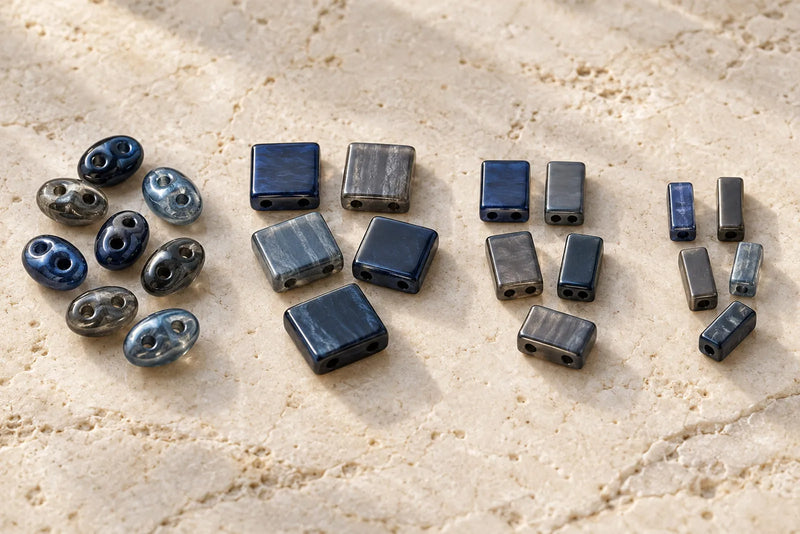
Specialty and two-hole beads
Specialty shapes often appear alongside round seed beads in supply listings. Check the side profile and number of holes as well as the outline from above.
Glass spacer beads
Glass spacers are thin beads that fit between other beads or components. Their shallow profile can add a small accent without taking up as much room along the thread as a deeper bead. Check the material: the word "spacer" is also used for metal and other components.
SuperDuo beads
SuperDuo beads are shaped, pressed glass beads with two holes. MATUBO lists them at 2.5 × 5 mm. The second hole provides another path through the bead, allowing patterns to connect neighboring rows or motifs.
Use a pattern's specified two-hole bead. A similar outline doesn't guarantee matching hole positions or spacing.
TILA, Half TILA, and Quarter TILA beads
TILA is MIYUKI's flat, two-hole bead family. A full TILA bead is square from above; Half TILA and Quarter TILA beads are narrower rectangles. All three have two parallel holes.
| MIYUKI bead family | Approximate dimensions: length × width × thickness |
|---|---|
| TILA | 5 × 5 × 1.9 mm |
| Half TILA | 5 × 2.3 × 1.9 mm |
| Quarter TILA | 5 × 1.2 × 1.9 mm |
Half and Quarter describe width variations within this family. They aren't aught sizes, and each bead still has two holes. Check both openings before starting, then follow the pattern's thread path.
Seed bead brands and product families
MIYUKI and TOHO are Japanese manufacturers. Both offer multiple bead families, so saying "Miyuki beads" or "Toho beads" doesn't identify one particular shape. Czech manufacturers, including Preciosa Ornela, also produce a range of seed beads and cut styles.
Read the full label. "MIYUKI Delica 11/0" gives you more useful information than "Japanese beads." It names a manufacturer, a product family, and a size designation. The color or finish number helps identify the remaining details.
When comparing brands, keep the shape and intended use consistent. Compare a round with a round, or a cylinder with a cylinder. Then look at dimensions, hole size, and the pattern's requirements.
For beadwork where the rows must line up, make a small sample before replacing the specified beads. It can reveal a difference in spacing or tension while you still have only a few rows to undo.
How are seed beads sized?
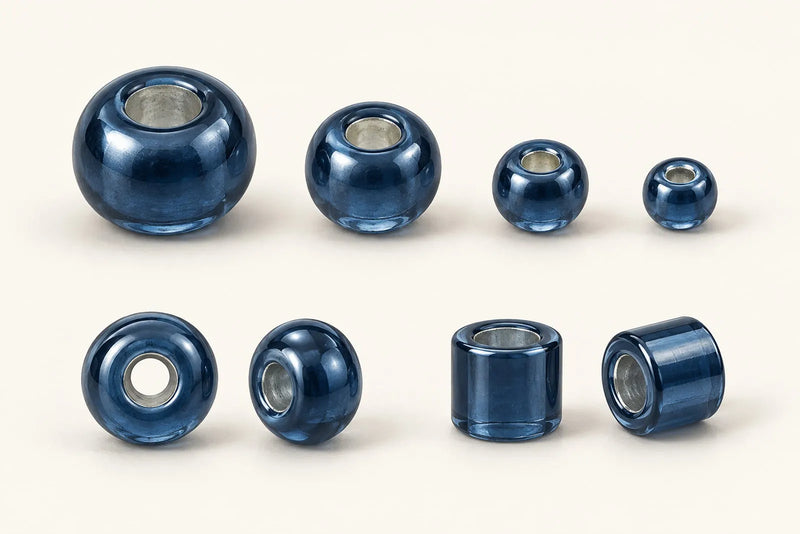
Seed bead sizes often use an aught number, written as 6/0, 8/0, 11/0, or 15/0. Within a comparable bead family, a larger number generally means a smaller bead.
The number isn't a universal millimeter measurement. These examples come from MIYUKI's measurements for round and cylinder beads.
| MIYUKI bead family | Size | Approximate outer diameter |
|---|---|---|
| Round rocaille | 6/0 | 4.5 mm |
| Round rocaille | 8/0 | 3.0 mm |
| Round rocaille | 11/0 | 2.0 mm |
| Round rocaille | 15/0 | 1.5 mm |
| Delica cylinder | 10/0 | 2.2 mm |
| Delica cylinder | 11/0 | 1.6 mm |
Notice the two 11/0 entries. The round rocaille and the Delica share a size label, but their listed outside diameters differ.
Also check the hole diameter separately. The bead must accommodate the cord or the needle and thread, including any repeated passes a pattern requires. Outside diameter doesn't tell you that on its own.
Keep the manufacturer's name and bead family beside any seed bead size chart you save. Without them, a convenient reference can turn into a misleading conversion table.

What seed bead finish names tell you
Shape determines the outline. Glass color, opacity, and surface treatment affect how that outline looks in the light.
The Knosos Picasso Seed Bracelet combines 2 mm blue-gray Miyuki Picasso-finish seed beads with gray cord. Its mottled surface illustrates what "Picasso" describes: an applied finish, rather than a separate stone material or a different bead shape.

KNOSOS PICASSO SEED BRACELET
Common descriptions include:
- Opaque: the glass doesn't let you see through it.
- Transparent: light passes through the glass clearly.
- Matte: a less reflective surface with a frosted appearance.
- Color-lined or silver-lined: an effect within the bead's hole.
- AB or rainbow: an iridescent surface effect.
- Metallic or plated: a metal-like surface or an applied metal treatment, depending on the product.
- Picasso: a mottled or speckled surface effect.
Several descriptions can apply to one bead. A bead can be opaque and matte, for example. Picasso and matte describe different characteristics, so they shouldn't be treated as interchangeable names.
Finish also affects care. Check the specific manufacturer's color or treatment information before assuming a coating will tolerate water, friction, or cleaning products. A brand name isn't a promise that every finish has the same durability.
How are seed beads made?
Many glass seed beads begin as hollow glass tubes. In the process described in MIYUKI's explanation of glass tube drawing, raw materials are melted, then the glass is drawn into slender tubes while air forms the opening.
Those tubes are cut into bead-length sections. Further processing shapes and smooths the beads where appropriate, and additional treatments may add color, lining, or other surface effects. The hole is formed as part of the tube-making process, rather than drilled into every tiny bead afterward.
The details depend on the product. A long bugle and a rounded rocaille need different treatment to retain their intended shapes. This is one manufacturer's documented process, not a recipe for every bead sold under the seed bead label.
Choosing a seed bead type for your project
For a simple strung bracelet, start with the bead's overall size, its hole, and how it sits beside the next bead. For a geometric woven band, the specified shape and dimensions become especially important.
| Your project | Start by checking |
|---|---|
| A single strung row | Outside diameter, hole size, and cord compatibility |
| A flat geometric pattern | The named bead family and how the beads align |
| Fringe | Bead length, weight, and how each shape hangs |
| Embroidery | The shape's profile and the thread path around neighboring beads |
| Two-hole beadwork | The specified bead family, hole positions, and thread path |
You can see those choices in three starter projects made with seed beads, which use different constructions rather than one interchangeable supply list.
A finished bracelet is another useful scale reference. Looking at the proportions of finished seed bead bracelets can help you judge how a narrow row or a wider band will look on a wrist.
Before starting, set out a short row or stitch a small sample with the actual beads. Check the spacing, the direction of any shaped beads, and the number of thread passes. It's easier to change a few beads on the table than a finished bracelet.
Seed bead FAQs
What's bigger, 10/0 or 11/0 seed beads?
Within a comparable bead family, 10/0 is generally bigger than 11/0. For example, MIYUKI lists 10/0 Delica at about 2.2 mm across and 11/0 Delica at about 1.6 mm. Compare the same manufacturer and family rather than treating aught numbers as universal dimensions.
What is the difference between seed beads and Miyuki beads?
Seed beads are a category of small beads. MIYUKI is a manufacturer that makes several seed bead families, including round rocailles and Delica cylinders. The useful comparison is between specific shapes and product ranges, not between seed beads as a whole and one brand.
Which beads are better, Toho or Miyuki?
The better choice depends on the particular beads and the project. Compare equivalent shapes, dimensions, hole sizes, finishes, and the pattern's supply list. If you want to substitute one for the other in precise beadwork, try a small sample first and check its spacing.

Save 20%
Coordinated pieces, ready to wear.

Up to 15%
Pick any 3 or 5 bracelets.
From a customer
★★★★★
“Still wearing it two months later.”
Nick Verified · Sicily set


