


A bead is a small decorative piece with a hole for threading or attachment. Common types of beads include glass, gemstone, metal, wood, polymer clay, ceramic, acrylic, pearl, and shell beads. Their names can also describe a shape, finish, or making method. A bicone is a shape, lampwork is a glassmaking method, and a spacer describes a bead's role in a design.
You can compare bead materials in finished bracelets to see how size, color, and texture change the overall design.
Different types of beads at a glance
This chart covers common bead names and their uses. The categories overlap: a small glass bead can also be a cylinder, have a matte finish, and serve as a spacer.
| Bead name | What to look for | Common uses |
|---|---|---|
| Round seed or rocaille | Small rounded beads with a central hole | Weaving, embroidery, narrow strands |
| Cylinder seed bead | Short tubes with relatively straight sides | Geometric beadwork and loom patterns |
| Bugle | Long, slender glass tubes | Fringe and linear details |
| Pony | Rounded barrel shapes with generous holes | Simple stringing and letter bracelets |
| Lampwork | Glass shaped in a flame; decoration varies | Focal details and strung jewelry |
| Millefiori | Patterned glass-cane slices within or fused to glass | Colorful strands and focal beads |
| Gemstone | Named stone cut and drilled into a bead | Bracelets, necklaces, earrings |
| Metal | Solid or hollow metal, sometimes plated | Accents, spacers, focal details |
| Wood | Carved or shaped wood, sometimes painted | Lightweight strands and larger designs |
| Polymer clay | Cured modeling material in discs or other shapes | Color blocks and handmade designs |
| Ceramic | Fired clay, often glazed | Textured accents and focal beads |
| Acrylic or plastic | Molded forms in many colors and sizes | Lightweight, colorful jewelry |
| Cultured pearl | A pearl grown in a mollusk with human assistance | Strands, drops, earrings |
| Shell or mother of pearl | Cut shell material with visible surface character | Discs, chips, shaped accents |
| Two-hole bead | Two separate holes through one bead | Patterns with specific thread paths |
The Paros Picasso Seed Bracelet is a useful example of overlapping names. Its 2 mm glass seed beads have a Picasso finish. “Seed” names the bead family; “Picasso” describes the surface treatment.

PAROS PICASSO SEED BRACELET
Beads by material
Start with the material, then consider shape and finish. Two beads that look alike can differ in weight, composition, or care requirements. The material description matters more than the color name.
Glass beads
Glass beads may be transparent, translucent, or opaque. They include small seed beads, pressed shapes, faceted beads, and individually worked glass. Some colors come from the glass itself; others come from coatings or linings. Check which finish you are buying if the beads will rub against one another.
Gemstone and stone beads
Stone bead listings may name jasper, agate, quartz, or another material. The stones can be cut into rounds, chips, cubes, or drops. Natural variation is possible, but variation alone does not prove authenticity. Ask about treatments and the actual material behind a trade name.
For jasper, the guide to jasper varieties and trade names explains why stones sold under related names can look quite different.
Metal beads
Metal beads can be solid, hollow, textured, or plated. Check the stated metal rather than assuming that a silver-colored bead is sterling silver. Size alone does not tell you how heavy it will be: a hollow bead and a solid bead of the same diameter can feel very different.
Wood and other natural materials
Wood beads may show grain, carving, paint, or a polished surface. Seeds, coconut shell, bone, and horn also appear in beadwork. Read the material and finish details, particularly when choosing matching beads. A photograph may show the surface without establishing what lies underneath it.
Polymer clay
Polymer clay is a synthetic modeling material, distinct from earth clay. Sculpey's material description explains its PVC base and oven curing. Thin colorful discs are one familiar form, but polymer clay can also be shaped into rounds, patterned beads, and larger focal pieces.
Fired ceramic
Ceramic beads are made from clay hardened by firing. They may have a glaze or a painted finish, and their holes and surfaces can vary. Check the edges around the hole and the weight of the bead before planning a strand. “Clay bead” by itself is not a precise material description.
Acrylic, plastic, and resin
These beads offer many colors and molded shapes, including letter beads and imitation stone or pearl effects. A convincing pattern does not make them natural stone. If a listing uses only an appearance-based name, look for the composition elsewhere in the product details.
Pearls
Natural and cultured pearls grow in mollusks; cultured pearls involve human assistance. They differ from manufactured imitations. GIA's pearl overview identifies four major cultured whole-pearl groups: freshwater, Akoya, South Sea, and Tahitian. For a bead project, also check shape, drilling, and the seller's identification.
Shell and mother of pearl
Shell beads are cut and shaped from shell material. Mother of pearl is the nacreous inner shell layer used in many jewelry components. It is not a whole pearl. Shell pieces can be made into discs, chips, rounds, or other forms, so the finished shape does not identify the material on its own.
Common bead names and styles
Once you know the material, the other names become easier to sort out. Some describe the bead's form; others tell you how it was made or what it does in a design.
The Millefiori Bracelet Silver uses 4 mm patterned glass beads with sterling-silver spacers. The glass decoration and the spacers describe two different parts of the bracelet, rather than one bead material.

MILLEFIORI BRACELET SILVER
Seed beads, rocailles, and cylinders
Seed beads are small beads used in detailed work, though they come in several shapes. Rocaille commonly refers to a rounded seed bead. Cylinder seed beads have straighter sides; MIYUKI Delica is one named cylinder family. These types of seed beads can produce different surfaces in the same stitch.

Round seed, cylinder seed, and bugle beads have different profiles. This comparison is illustrative and is not to scale.
Seed bead sizing often uses aught numbers such as 8/0 or 11/0. Within a bead family, a larger number generally means a smaller bead. It is not a universal millimeter conversion: MIYUKI's size reference lists 11/0 Delica at about 1.6 mm across and 11/0 round rocailles at about 2 mm. Check the pattern's specified shape as well as its size.
For a wearable comparison, small glass beads in wearable designs show how a fine bead profile can become a continuous line of color.
Bugle and pony beads
Bugles are elongated glass tubes, often used to create straight lines or fringe. Check the hole edges and the pattern's thread requirements. Pony beads have a fuller barrel-like form and typically a generous hole, making them useful for simple strung designs. Neither name gives you every detail about material or size.
Lampwork and millefiori
Lampwork describes shaping glass in a flame. Millefiori describes decoration made with slices of patterned glass cane, which can show flowers, stars, rings, or other motifs. A bead can involve both methods: the Corning Museum of Glass bead record lists lampworking and millefiori together.
A floral appearance does not establish where a bead was made. The guide to patterned glass bead details explains what to check in the material, decoration, holes, and origin description.
Two-hole beads
Two-hole is a drilling description, not a material. A bead can have two holes and be flat, oval, or another shape. MIYUKI TILA and Czech SuperDuo are familiar examples with different forms. Use the bead specified by a pattern: matching the number of holes does not make two shapes interchangeable.
Spacers, focal beads, and finishing components
A spacer sits between other beads to separate them or create a visual pause. A focal bead draws attention within the design. Either role can be filled by different shapes and materials. Crimp beads and tubes have a separate job: they secure compatible jewelry wire in a suitable construction. Their sizing and fitting need their own instructions.
Common bead shapes and finishes
Shape names help you find the form you want without knowing its material first. A bicone can be glass or stone; a flat disc can be shell, polymer clay, or metal.

Common bead shapes. Side profiles help distinguish rondelles, thin discs, and coin beads; hole placement varies by product.

Tube, drop, briolette, and irregular forms. Check the hole position as well as the outside shape.
- Round: a spherical form.
- Bicone: two cone-like halves joined at their broad bases.
- Rondelle: a compressed round form, shorter through the hole than across.
- Heishi or disc: a thin disc or short disc-like cylinder.
- Coin: a circular form with broad flat or slightly puffed faces.
- Cube: a form with square faces; the drilling direction can vary.
- Tube: an elongated cylinder with a lengthwise hole.
- Drop or briolette: a drop-shaped form; briolette usually refers to a faceted drop. Check the hole position.
- Chip or nugget: an irregular form, with dimensions that may vary within a strand.
Rondelle, coin, and disc beads can look similar from the front. Compare thickness, the side profile, and where the hole passes through. Those details often explain the difference more clearly than the name.
What finish names tell you
A smooth polished surface looks different from a matte one. Facets are cut or formed faces that change how light reflects. AB, short for Aurora Borealis, describes an iridescent effect. Lined beads have color or a reflective finish in the hole. Picasso describes a mottled surface treatment on relevant glass beads.
A finish name does not identify the base material or promise that a coating will withstand every kind of wear. Check the manufacturer's finish information when a design depends on a particular surface effect.
Choosing beads for bracelets and other jewelry
Types of beads for bracelets
The Picture Jasper Bracelet uses 4 mm polished stone beads on adjustable cord. It illustrates a compact stone-bead profile, with beige and brown patterning that varies from bead to bead.

PICTURE JASPER BRACELET
For bracelets, consider how the beads sit against your wrist, how heavy the strand feels, and whether the holes suit the construction. A small change in bead profile can alter the entire bracelet.
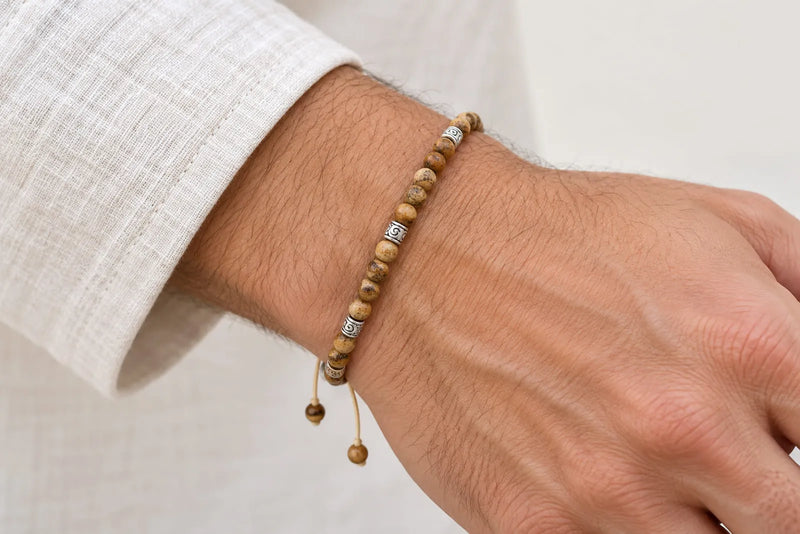
Small round beads and spacers form a narrow bracelet profile.
| Bead choice | Useful for | Check before starting |
|---|---|---|
| Small seed beads | Narrow strands or patterned beadwork | Shape, hole size, and thread passes |
| Smooth rounds | Simple strung bracelets | Weight, diameter, and cord fit |
| Heishi or disc beads | Closely stacked color blocks | Thickness, edges, and hole alignment |
| Patterned glass or stone | Visible accents or focal details | Dimensions, weight, and adjacent beads |
Choose the bead's outside diameter and its hole diameter separately. An 8 mm bead does not necessarily have a hole large enough for your chosen cord. For wearable proportions, the guide to bead size and wrist proportions compares smaller and larger profiles.
If you are mixing different types of beads for bracelets, lay out a short repeat first. Notice whether larger beads hide smaller ones, whether flat pieces overlap, and whether the combination bends comfortably before committing to the full length.
Necklaces, earrings, weaving, and embroidery
A necklace can accommodate a different balance of bead sizes than an earring. For earrings, consider the total weight and the way a top-drilled or lengthwise-drilled bead will hang. A bead that looks balanced on a strand may turn differently when suspended on its own.
For weaving and embroidery, follow the pattern's bead shape, size, and thread path. Check whether the needle and thread can pass through the hole as often as required. Uniformity can matter when rows need to line up closely; a looser strung design may allow more variation.
How to identify different types of beads
If you are looking at a loose bead and wondering what type it is, start with the features you can see. Naming the form is often easier than establishing the material.
- Check the outline. Is it round, cylindrical, flattened, faceted, or irregular?
- Look at the holes. Count them and note whether they run through the center, along the length, or near the top.
- Measure it. Record the length, width, and approximate hole diameter rather than relying on a photo alone.
- Read the packaging or listing. Look for a material, named bead family, size, and finish.
For types of beads with pictures, compare both a front view and a side view. A photo can help distinguish a bicone from a rondelle, but color, apparent weight, or a cool feel cannot conclusively prove a mineral identity or place of manufacture.
When the description is incomplete, ask the seller about the material and any treatments. Keep “I recognize the shape” separate from “I have verified the material.”
Types of beads FAQs
What are very small beads called?
They are often called seed beads. Rounded varieties are commonly called rocailles, while cylinder seed beads have straighter sides. Delica is a MIYUKI cylinder family. Check the actual shape and dimensions, because “small bead” or a size number alone does not identify the exact product.
How many types of beads are there?
There is no single universal total. Beads can be grouped by material, shape, finish, making method, or function, and those groups overlap. A useful bead chart covers recognizable examples rather than claiming that a fixed number includes every bead ever made.
Are crystal beads the same as gemstone beads?
“Crystal” may mean manufactured crystal glass or a crystalline gemstone such as quartz. These are different materials, even when they share a faceted shape. Read the material description. The word crystal by itself does not establish natural origin or a particular lead content.
Which bead types are commonly used?
Glass and seed beads appear in many strung and woven designs, while stone, metal, wood, pearl, and shell provide other textures and forms. Choose by the project. A bead suited to detailed weaving may be quite different from one chosen as a large necklace focal point.
Are bead types and beading techniques the same thing?
Bead types describe the components. Bead stringing, loom weaving, off-loom stitching, and embroidery describe ways to work with them. A technique can use more than one bead type. When you are ready to follow a design, reading a beadwork chart helps connect the bead list to the instructions.
Choose the material and shape you want, then check that the holes and construction suit the finished piece.

Save 20%
Coordinated pieces, ready to wear.

Up to 15%
Pick any 3 or 5 bracelets.
From a customer
★★★★★
“Still wearing it two months later.”
Nick Verified · Sicily set


