


Quartz is used in rings, necklaces, earrings, and bracelets, with clear, colored, and patterned varieties offering very different looks. When choosing quartz for jewelry, consider the specific variety, how the piece is made, and the wear it will receive. Its Mohs hardness of 7 makes it a useful jewelry material, but it can still scratch or chip.
If you prefer a discreet bracelet, start by comparing bead size and color. Maresi's small stone bracelets in different colors offer a way to see how those choices change the overall look.
The Tiger Eye Bracelet pairs golden-brown 4 mm beads with an adjustable cord. Its small bead profile shows how a patterned quartz gemstone can work in a bracelet without becoming a large statement piece.

TIGER EYE BRACELET
Which types of quartz are used in jewelry?
Clear rock crystal is only one member of the family. Amethyst, citrine, rose quartz, and smoky quartz are also quartz. Agate and jasper belong to the broader group of fine-grained quartz materials, while tiger's eye has its familiar shifting reflection.
You can see that breadth in the quartz family in the Smithsonian collection. A transparent faceted stone and an opaque patterned bead can share a family connection while looking quite unlike each other.
| Quartz variety or material | What you see | What to consider for jewelry |
|---|---|---|
| Clear quartz, or rock crystal | Colorless transparency | A faceted cut emphasizes reflections; a polished bead gives a simpler look. |
| Rose quartz | Pink, usually with cloudy translucence | Compare the actual shade and translucence rather than expecting a clear pink gem. |
| Smoky quartz | Transparent gray to brown | Check whether the color remains visible in the size and lighting shown. |
| Amethyst | Purple | Choose a shade you enjoy; protect it from prolonged intense light and heat. |
| Citrine | Pale yellow to brownish orange | Ask about treatment. Much commercial citrine is produced by heating amethyst. |
| Rutilated quartz | Needle-like mineral inclusions | The pattern inside the stone is part of its appeal. |
| Agate and jasper | Bands, markings, or opaque color | Assess the pattern across the beads, not just the name of the material. |
| Tiger's eye | A silky band that moves with the light | Look for a video or several angles to understand the effect. |
Quartz gemstone jewelry does not need to be completely clear to be attractive. Cloudiness is characteristic of much rose quartz; visible inclusions are the reason people choose rutilated material. Judge the stone against its own variety.
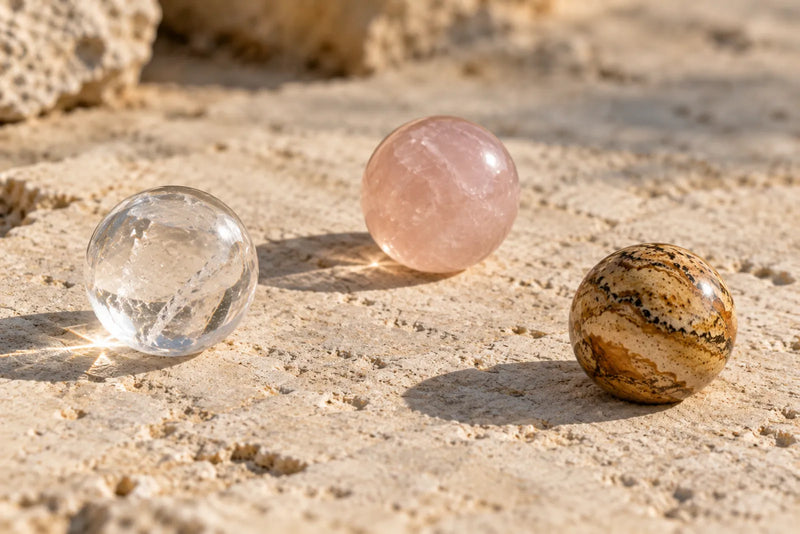
Our explanation of why tiger's eye reflects a moving band goes into that optical effect. The guide to quartz patterns in agate covers another side of the family.
How quartz forms
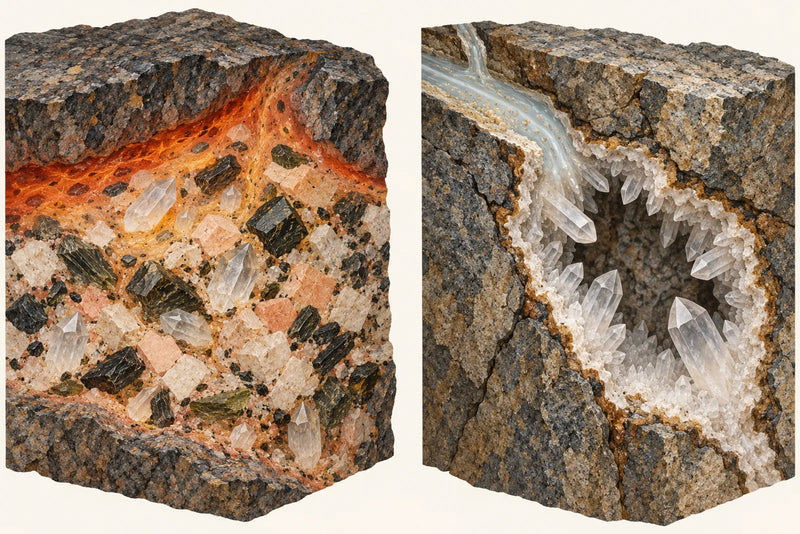
Quartz forms when silicon and oxygen become arranged in a repeating crystal structure. It can crystallize as magma cools, or grow from silica-bearing fluids moving through rock. When those fluids reach conditions in which dissolved silica comes out of solution, quartz can form in cracks and cavities.
Growth conditions help determine the result. Crystals growing with room around them can develop recognizable faces. Elsewhere, quartz fills spaces between other minerals or occurs as masses of crystals too small to see individually.
Understanding how quartz crystals are formed helps explain their different appearances. A crystal point, a clear cut gem, and a fine-grained patterned bead need not look alike. Their appearance reflects crystal size, inclusions, and the conditions under which the material developed.
For a jewelry buyer, the useful question is how that structure looks after cutting and polishing. A pointed mineral specimen is not automatically the best shape to wear against a cuff or wrist.
Is quartz durable enough for everyday jewelry?
Quartz is reasonably scratch-resistant, but hardness measures resistance to scratching, not resistance to every kind of damage. A hard knock can chip a stone, particularly at an exposed edge.
GIA's advice on amethyst wear and cleaning describes amethyst as suitable for all jewelry types, including rings, with proper precautions. It also notes that sand and dust contain quartz. A hardness of 7 does not mean a stone can be rubbed against grit indefinitely without wear.
Consider how the piece will be worn. A pendant usually encounters fewer knocks than a ring or bracelet. With a bracelet, look at bead surfaces, drill holes, cord condition, and any metal components as well as the stone.
The Moss Agate Bracelet uses polished 4 mm beads on a gray adjustable cord. Its green markings and pale areas give a different effect from transparent quartz, while the compact beads offer a restrained way to wear patterned stone.

MOSS AGATE BRACELET
Remove stone jewelry for tasks likely to knock, scrape, or snag it. A smooth bead still needs sound construction, and the stone's hardness tells you little about the lifespan of a cord or clasp.
How much is quartz worth?
There is no single price for quartz. The word covers common material, selected cut gems, and collector specimens, so a price per pound cannot be applied directly to a finished bracelet or ring.
Many quartz gems are relatively affordable. GIA notes that even fine citrine can remain modestly priced in large sizes. That makes a useful buying point: a larger quartz stone does not automatically carry the scarcity premium associated with some other gems.
For jewelry, compare the variety, color, cut or polish, condition, and any treatment information. Then consider the rest of the piece: metal, setting, bead matching, construction, and workmanship. Two pieces with the same stone name can have very different specifications.
If you are asking how much a quartz crystal is worth, first distinguish a mineral specimen from material cut for jewelry. Crystal form and condition matter to a collector; wearability and construction matter to someone choosing a bracelet. Weight alone cannot settle either price.
Ask what supports an unusually high asking price. A trade name or an impressive size is not a valuation, and a retail listing does not establish what you could resell a piece for.
What to check before buying quartz jewelry
Look for a specific material name. “Crystal” alone does not tell you whether you are buying natural quartz, laboratory-grown quartz, glass, or another material.
Laboratory-grown quartz shares the essential properties of natural quartz. An imitation, such as glass made to resemble a gemstone, is a different category. Treatment is another question: a natural stone may have had its color changed. Ask separately about identity, origin as natural or laboratory-grown material, and treatments.
Use photographs to judge appearance, not to prove authenticity. Request a view in ordinary light and a close-up of the actual piece when possible. For a purchase whose identity matters to you, seek clear documentation or advice from a qualified gemologist.
With beads, inspect the polish, edges around the holes, and consistency of the overall strand. Natural pattern variation can be appealing; chipped edges and poor finishing deserve closer attention. Check measurements rather than estimating size from a tightly cropped photograph.
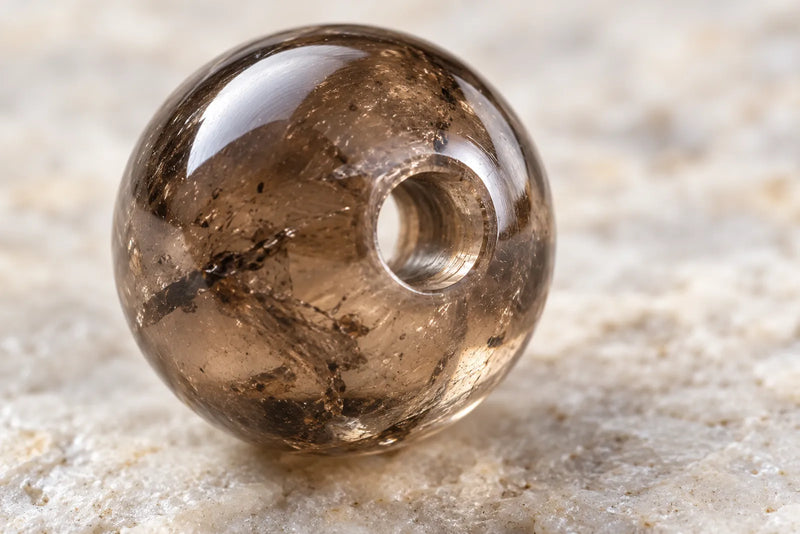
Color alone is not enough to identify an opaque stone. Understanding the fine-grained structure of jasper helps explain why it looks different from clear quartz even though the materials are related.
Choosing a quartz look you will wear
Start with the clothes you already reach for. Smoky brown, muted green, and earthy patterns are easy options to compare with navy, denim, olive, or beige.
The Picture Jasper Bracelet combines beige and brown 4 mm beads with an adjustable nautical cord. It is an example of the opaque, patterned side of the quartz family, suited to a reader who prefers earthy colors to a transparent stone.

PICTURE JASPER BRACELET
Clear quartz jewelry gives a different effect because you see light through the stone; an opaque bead puts more emphasis on color and surface pattern.
Check how the bead diameter and bracelet fit work together. If you wear a watch, leave enough room that the pieces do not continually rub against each other. A close-up product image tells you about the beads; a wrist image helps you judge their scale.
Caring for quartz jewelry
For untreated quartz varieties such as amethyst and rose quartz, warm soapy water is a suitable stone-cleaning method. The whole piece may need a different approach. Cord, plated parts, adhesives, other stones, and particular treatments can change what is appropriate.
Follow the maker's care instructions. For the cord bracelets mentioned here, use a soft cloth and remove them before exercise or contact with household chemicals. Do not assume that a stone's tolerance for water makes the bracelet suitable for soaking.
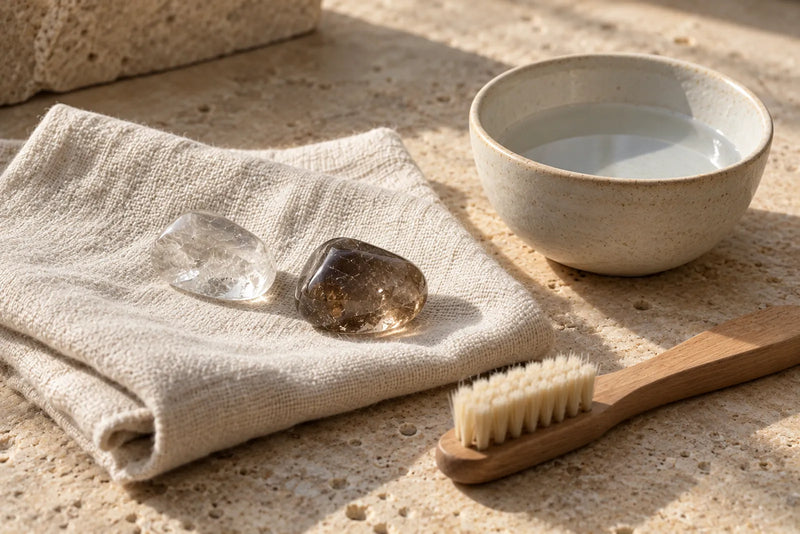
Avoid abrupt temperature changes. Some amethyst can fade under prolonged intense light, and GIA advises against steam cleaning it. Rose quartz has its own guidance, which excludes ultrasonic and steam cleaners. Keep pieces apart in storage so they do not scrape against one another.
FAQs
Does quartz jewelry tarnish?
Tarnish concerns the metal components rather than the quartz itself. If a piece changes color, identify which part has changed and check the metal, plating, and care instructions before choosing a cleaning method.
Can raw quartz be made into jewelry?
Yes. Quartz can be cut and polished, and suitable crystal points can be held in a wire setting. A wearable piece needs secure construction and a shape that will not catch or press uncomfortably against the wearer.
Is every clear crystal quartz?
No. Clear-looking jewelry materials can include glass and other gemstones as well as quartz. Appearance alone is not a reliable identification, so look for a precise description and appropriate documentation.

Save 20%
Coordinated pieces, ready to wear.

Up to 15%
Pick any 3 or 5 bracelets.
From a customer
★★★★★
“Still wearing it two months later.”
Nick Verified · Sicily set


