

Millefiori beads are decorated glass beads made with slices of patterned glass cane. Their name means “a thousand flowers” in Italian, although the designs can also resemble stars, rings or geometric shapes. The tiny pictures come from the cane’s cross-section, rather than a flower painted onto the finished bead.
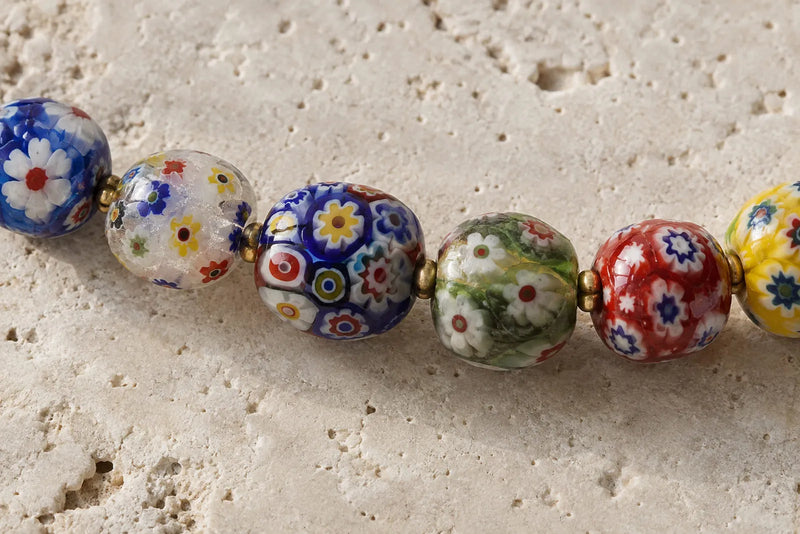
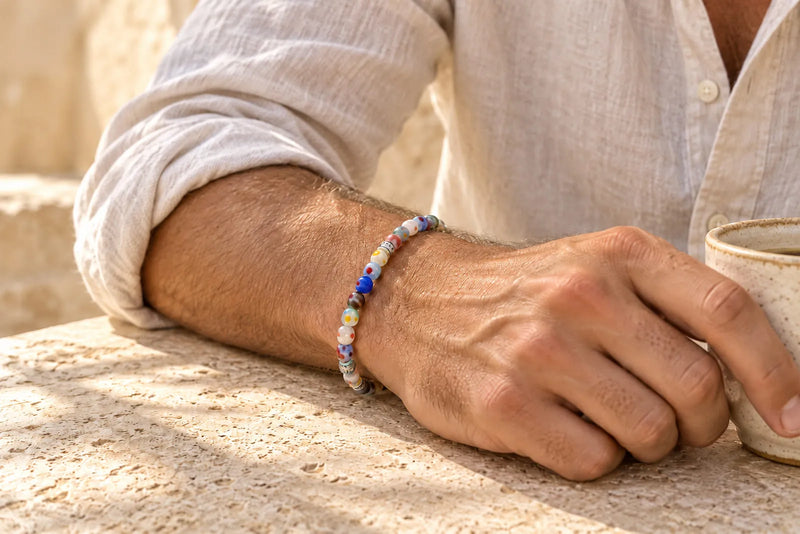
Understanding that construction helps when comparing bead sizes, checking quality, or deciding what to make of a seller’s Murano or vintage claim. In a bracelet with 4 mm millefiori beads on an adjustable cord, notice how small the motifs look at wrist distance.
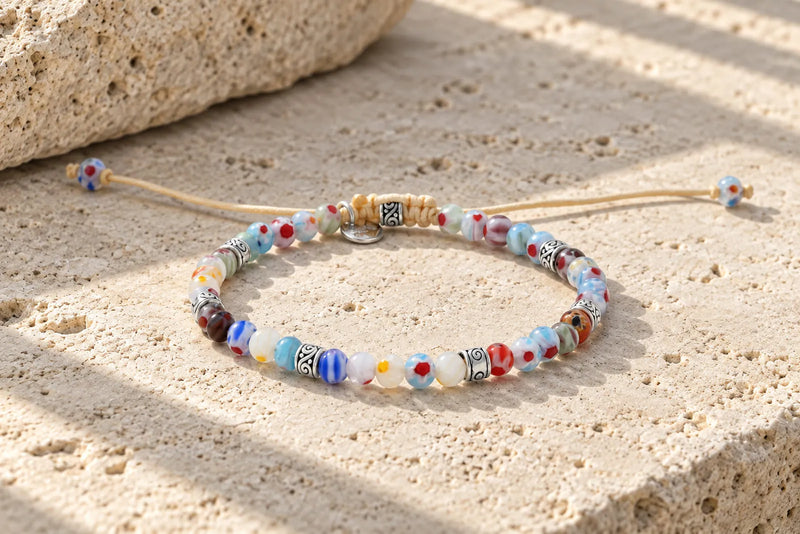
The Millefiori Bracelet Silver shows how the scale changes what you see. Up close, individual motifs are visible. From farther away, the glass reads as a row of small spots of color.

MILLEFIORI BRACELET SILVER
What are millefiori beads?
Look closely at a bead and you may see several small designs beside one another: a white flower, a blue ring, perhaps a red star. Those motifs come from patterned cane slices, often called murrine, fused into the glass. Some cover most of the surface; others leave the underlying glass visible.
Scale changes how much of that detail you notice. Maresi’s design with 4 mm glass beads and sterling silver spacers gives one example of small beads used in finished jewelry. A close-up reveals individual motifs that are less distinct at normal viewing distance.
How are millefiori glass beads made?
One familiar method combines patterned cane with a hot glass core:
- Build the cane pattern. Different colors of glass are assembled or layered so their arrangement forms a design through the cane.
- Draw the cane thinner. The hot glass is stretched, reducing the pattern while carrying it along the rod.
- Cut cross-sections. Once cooled, the cane is sliced across its width to reveal the miniature designs.
- Apply the slices. Small sections are placed against a hot glass bead core, commonly formed around a metal rod called a mandrel.
- Fuse and shape. Reheating joins the decoration to the core. The maker shapes the bead and may add clear glass over the pattern.
- Cool and finish. Controlled cooling, called annealing, relieves internal stress. The opening is cleaned and the surface finished as needed.
Workshop methods vary. This sequence explains a common way to make a decorated bead; it is not a recipe for every object sold under the name.
Millefiori, murrine and lampwork: what is the difference?
The words describe different aspects of the work.
| Term | What it describes |
|---|---|
| Millefiori | The decorative technique or effect created with patterned cane sections. |
| Murrine | The patterned glass sections used to build the decoration. |
| Lampwork | Forming and working glass in a flame. |
A bead can be both lampworked and millefiori. The Corning Museum of Glass bead record lists both techniques for a historic Venetian example.
Terminology varies between makers and collectors. A useful practical distinction is to think of murrine as the patterned pieces and millefiori as the decoration they create. Lampworked dots or swirls alone do not establish that cane slices were used.
A short history of millefiori beads
Mosaic-glass methods existed before the Venetian tradition associated with the name today. Corning traces the Venetian technique to Roman predecessors and describes its much wider use during the nineteenth century.
Venetian millefiori beads became an important part of the African bead trade. Corning’s example is dated broadly to 1845–1950, a reminder that even a documented museum object may have a date range rather than a single year.
“Trade bead” describes a bead’s exchange or use history. It does not, by itself, identify where the glass was made. Likewise, a colorful mosaic pattern cannot establish that a bead is old.
Shapes, sizes and holes
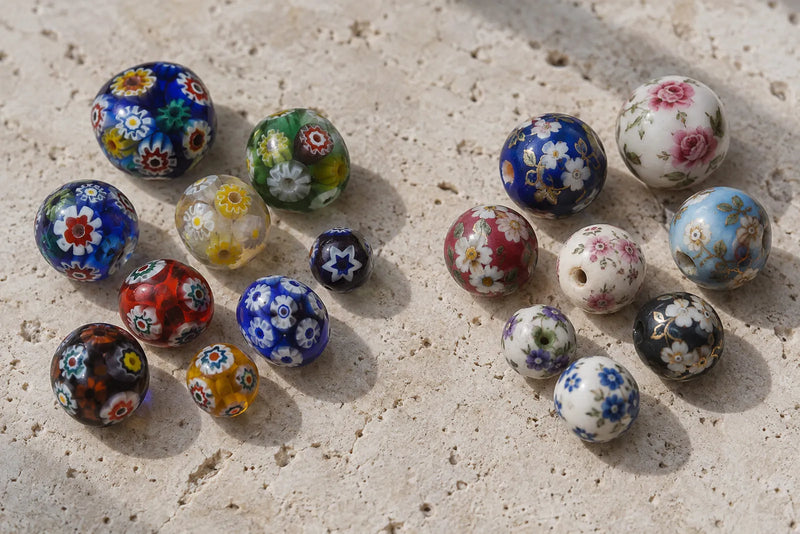
Round beads are only one option. Coins, barrels, cylinders, cubes and other shapes give the same patterned glass a different outline.
| Shape | What to check |
|---|---|
| Round | Diameter, consistency and whether the hole passes through the center. |
| Coin or flat round | Face diameter, thickness and hole direction. |
| Barrel or cylinder | Both length and width; one measurement does not describe the whole bead. |
| Cube or other angular shape | Dimensions, corners and whether the edges feel smooth. |
At about 4 mm, individual motifs are subtle. At 6 or 8 mm they are usually easier to distinguish, while 10 or 12 mm beads occupy more space in a design. Size is a choice about proportion, not a quality grade.
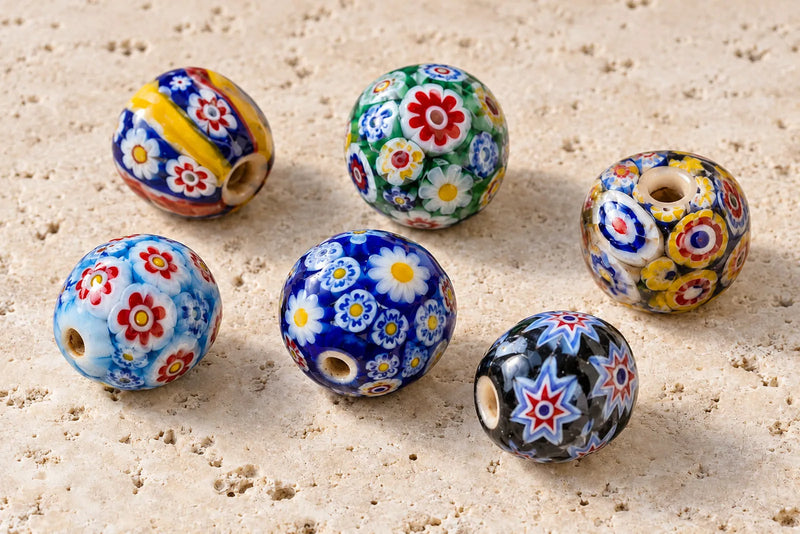
For loose beads, ask for the hole diameter as well as the outer dimensions. Check that the opening will accept your chosen stringing material and any extra passes your design needs. A close-up cannot substitute for a stated measurement.
Compare the selling unit too: a single bead, a counted pack and a strand are different offers. For strands, check length and approximate bead count. Decorative cane slices sold for mosaics may have no holes at all.
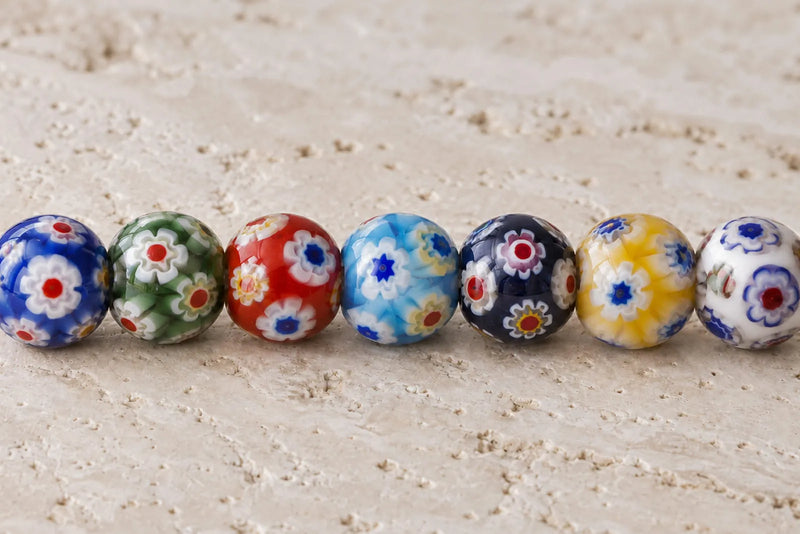
The Millefiori Bracelet uses round 4 mm beads. At that size, the outline of the strand is easy to see while the details in each bead come into focus only at close range.

MILLEFIORI BRACELET
Glass, polymer clay and painted lookalikes
Traditional glass millefiori uses patterned glass cane. The same pattern-building idea also works in polymer clay: the maker builds a colored cane, slices it, and uses the sections to form or cover a bead. STAEDTLER’s clay bead tutorial demonstrates this approach.
A clearly labeled clay example is a different material choice. The problem is an unclear or inaccurate description, such as presenting plastic as glass.
Read the material field and examine front and side views. A pattern fused into glass differs from surface printing, but photographs alone may not settle what a bead is made from. Weight, cool touch and small irregularities are not conclusive tests. Avoid scratching or heating a piece to investigate it; ask the seller for material details instead.
Venetian and Murano beads: checking origin
Millefiori describes a technique or decoration. Venetian refers to Venice; Murano identifies a place of manufacture within its glassmaking tradition. Makers elsewhere can work with patterned cane too.
When a listing claims Venetian millefiori beads or Murano millefiori beads, ask what supports that origin: a named maker, traceable label, purchase records or other credible documentation. “Murano style” does not establish Murano production.
The Vetro Artistico Murano origin mark is one formal form of certification. Its absence alone does not establish another origin. Neither uneven flowers nor clean holes can tell you which workshop made a bead.
For more about the technique beyond beads, read how millefiori glass is made.
Vintage and antique beads: age and value
Vintage millefiori beads and antique millefiori beads need age evidence separate from their pattern. Ask how the seller reached the date and whether records, collection history or a documented comparison support it. Wear can be a clue to use, but it cannot supply an exact age.
When comparing prices, consider:
- The evidence for age, maker and origin.
- Condition, including cracks, chips and worn openings.
- Size, pattern and whether the group is matched or assorted.
- Whether the price is for one bead, a strand or a completed piece.
A higher price does not prove authenticity. For a costly collectible, request the evidence before deciding what an age or origin claim is worth to you.
How to check quality before buying
Start with clear photographs of several beads, including a side view and the openings. A macro image shows detail but can make the scale hard to judge.
Check five things:
- Pattern: Can you distinguish the motifs? They do not need to be identical.
- Surface: Look for cracks, chips or sharp raised areas.
- Holes: Inspect the rims for damage and check the stated size. Rough openings can wear against cord.
- Shape: Small differences may be acceptable; a chipped corner or thin, damaged edge needs closer attention.
- The group: Colors, dimensions and quantities should match the listing.
Flowers can stretch or tilt as glass is shaped. That variation does not automatically mean poor quality, nor does it prove handmade production. A crack deserves more attention than two flowers with different outlines.
Photographs cannot verify annealing or reveal every internal fault. Clear specifications and return terms are more useful than an unexplained “premium quality” label.
For finished jewelry, check the other components separately. Silver-colored is not the same as sterling; the FTC’s silver jewelry guidance explains the 92.5% silver standard. A metal description says nothing about the glass’s geographic origin.
Also inspect the closure, fit range and cord near the openings. Our guide to glass beads in finished jewelry covers those construction choices in more detail.
Use the Millefiori Bracelet Silver to practice comparing several motifs at once. Look separately at the shape of each motif and the surface of the bead, since a stretched flower and a chipped edge tell you different things.
MILLEFIORI BRACELET SILVER
Cleaning and storage
Wipe the beads with a soft, slightly damp cloth, then dry them. Follow the maker’s instructions for the complete item: cord, metal, coatings and adhesives may need different care from bare glass.
Keep perfume and strong cleaners away from the piece. Remove jewelry before swimming or showering, and store it separately so the glass does not knock against harder items. Avoid abrasives and ultrasonic cleaning unless the maker approves every component. Have cracked beads or fraying cord repaired before wearing the piece again.
Frequently asked questions
What does millefiori mean?
Millefiori means “a thousand flowers” in Italian. The name refers to the clustered miniature patterns associated with the technique. Flowers are familiar motifs, but patterned cane can also create stars, rings and geometric forms.
How are millefiori beads made?
One common method fuses slices of patterned glass cane onto a hot glass bead core. The maker reheats and shapes the decorated bead, then cools and finishes it. Methods vary, so the name does not specify every workshop step.
What is the difference between murrine and millefiori?
Murrine are patterned glass sections cut from cane. Millefiori describes the decorative effect or technique made with those sections. Usage varies, but the pieces-versus-decoration distinction helps explain how a bead is constructed.
Are all millefiori beads made in Murano?
No. The technique is associated with Venice and Murano, but it can be practiced elsewhere. A flower pattern does not prove geographic origin. Look for reliable maker information or records supporting the seller’s claim.
Can millefiori beads be made from polymer clay?
Yes. Makers can build and slice patterned polymer-clay canes to create millefiori designs. The material should be clearly identified as clay rather than glass. The Illinois State Museum’s bead lesson uses clay to demonstrate the construction.
What affects the value of vintage millefiori beads?
Documented age and origin, maker, condition, pattern, size and the selling unit all affect comparisons. A floral design or worn surface alone cannot establish age. Ask for the evidence behind a collectible description before paying a premium.
-

$20.99 USD
View product -

$11.99 USD
View product -

MULTICOLOR SHAMBALLA CLAY BRACELET
$15.99 USD
View product


Save 20%
Coordinated pieces, ready to wear.

Up to 15%
Pick any 3 or 5 bracelets.
From a customer
★★★★★
“Still wearing it two months later.”
Nick Verified · Sicily set


