


Start with round beads and a spool of jewelry elastic. For the easiest of these five free beaded bracelet patterns, string four dark beads for every light one. If you want a single accent, put one contrasting bead in the center and build out from both sides. You'll find the exact bead order and counts for both below, plus three patterns with wider bands of color.
If you're deciding how wide to make your first strand, compare bead sizes on finished bracelets. The Tiger Eye Bracelet uses 4 mm stone beads. Its golden brown bands show how much detail you can see in a strand slim enough to sit next to a watch.

TIGER EYE BRACELET
What you need for these bracelets
- Round 4 mm beads in two or three colors, depending on the pattern. Set aside a few extra beads in your main color.
- Jewelry elastic, scissors and a bead stopper or a piece of tape.
- A ruler and a bead mat or folded towel to keep the layout from rolling.
Most examples below use 40 beads, which comes to about 160 mm (6.3 inches) in a straight row. Use that number to plan your layout. The fit depends on the inside of the loop and the opening you need to slip it over your hand. Two bracelets with the same straight bead length can fit differently if one uses larger beads.
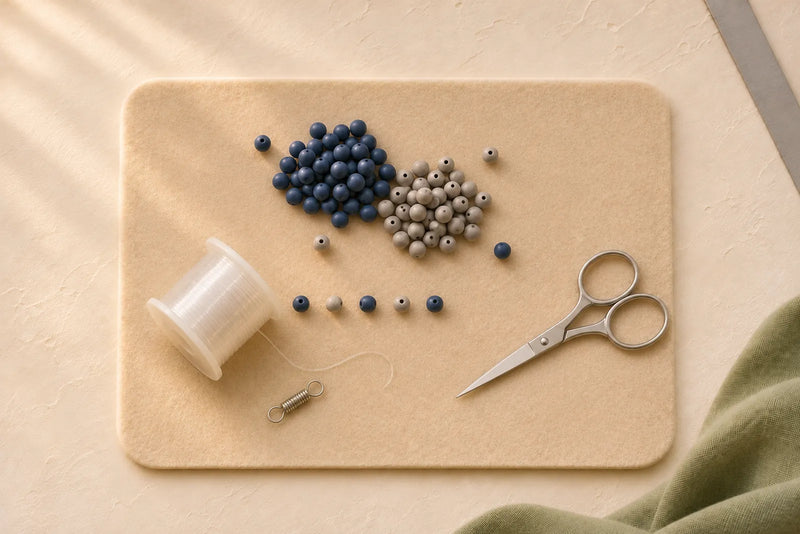
Pass a scrap of elastic through a few beads before cutting your working length. Try the accent beads too. The outside diameter tells you what a bead looks like in the pattern, while the hole determines what fits through it. If you're choosing between materials, use this guide to match bead holes to cord or wire.
Sort the colors into little piles and set out one full repeat. Even a modest contrast can be enough. Try charcoal beads with a bronze-colored accent, or navy and a gray that's light enough to pick out across the table.
Five beaded bracelet patterns
| If you want | Start with |
|---|---|
| An evenly spaced accent | Four dark beads between each light bead |
| One detail at the front | A single centered bead |
| A pattern that reads from a distance | Two wide color blocks |
| A third color in a small dose | Three-color bands |
| A little more contrast than a single dot | Paired accents |
Each letter in a sequence represents one bead. The color suggestions are starting points. Set the first and last beads next to each other on the mat to see what the repeat will look like at the join.
1. Evenly spaced accents
Use matte navy for A and warm gray for B. String A A B A A eight times for 32 A and 8 B. Once you make the loop, each gray bead has four navy beads between it and the next gray bead, including across the join.
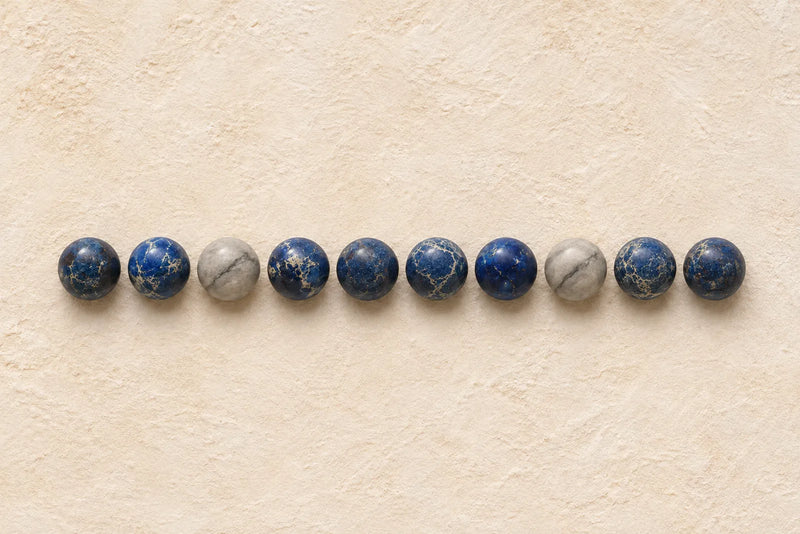
A full repeat adds about 20 mm. For a smaller adjustment, add one navy bead at each end for about 8 mm more. That makes the gap at the join a little wider, so put that part underneath the wrist. If you want the spacing identical all the way around, test a full repeat or change the spacing evenly between accents.
2. Single centered accent
Lay out 20 A, 1 B, 20 A. With 4 mm beads that gives you about 164 mm of beadwork. Charcoal glass with one silver-colored bead works well if the bracelet will sit by a steel watch. For less contrast, try dark brown with a lighter stone bead of the same size.
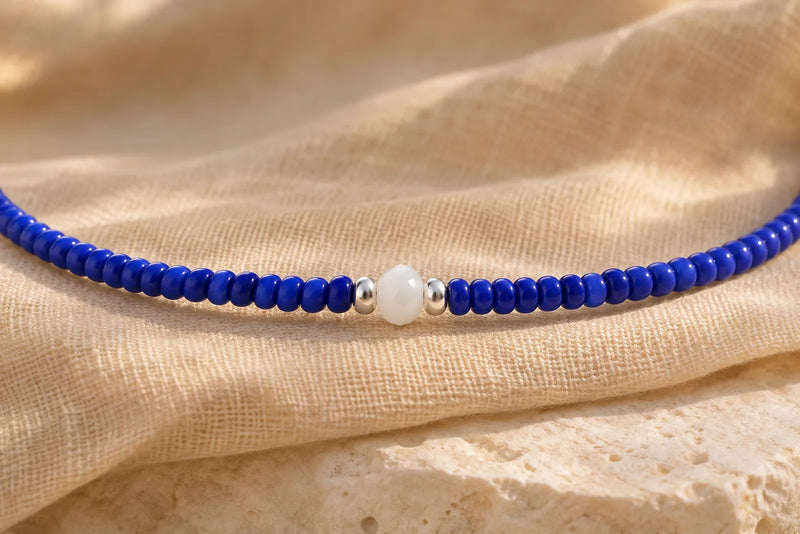
Add or remove the same number of A beads from both ends. One bead from each end shortens the row by about 8 mm. Change the bead count at the ends so the distances from the focal bead to the join stay equal.
The Loreto Blanco Diamanti Seed Bracelet uses a white focal accent against black beads. An off-white bead on charcoal gives you a softer version of that contrast.

LORETO BLANCO DIAMANTI SEED BRACELET
3. Two-color blocks
String five A followed by five B. Repeat the ten-bead group four times for 20 A and 20 B. The band ends in B and starts in A, so the color also changes at the join. Medium brown and black make the blocks easy to see without a bright accent.
To shorten it by about 16 mm, remove one A bead from each of the four A blocks. All the A blocks will still match. You can remove one B from each B block instead if you want more of the A color showing.
4. Three-color bands
Use a dark A, medium B and light C. Try slate, muted blue and sand. String A A A A B B B C C B four times for 16 A, 16 B and 8 C. The one B at the end puts a middle tone between the light pair and the next dark block.
For about 16 mm more length, add one A to each dark block. The two sand beads in each repeat stay together, and the transition back to the dark color still passes through B. Lay out two repeats next to each other first. A blue that looks pale by itself may sit much closer to the slate than it did in the packet.
5. Paired accents
String A A A A B B A A A A four times for 32 A and 8 B. Between each pair of accents you'll see eight base beads, including at the join. Try dark brown rounds with two dull brass-colored beads in each pair.
If the strand needs about 8 mm more, add two A beads together in the gap where the cord ends meet. For an even 16 mm increase, add one A in each of the four gaps. Count the gap across the join with the strand curved on the mat. It's easy to stop counting at the end of the row and overlook the beads at the other end.
The Paros Picasso Seed Bracelet pairs blue and gray glass beads. For a similar palette with paired accents, try gray for the long runs and two blue beads for each interruption.

PAROS PICASSO SEED BRACELET
Fit and finish your bracelet
Before cutting the elastic, wrap a flexible tape around your wrist where the bracelet will sit. Use the measurement to pick a starting bead count. After stringing, hold the cord ends together so you can check the loop before tying. It should rest comfortably without the cord pulling between beads. Check that the finished size will slip over your hand with a gentle stretch.
For a 7 1/4-inch wrist, try laying out ten full repeats of the navy-and-gray pattern. That gives you 40 navy beads and 10 gray beads, about 200 mm (7.9 inches) in a straight row. Hold the ends together around your wrist and check the fit before tying.
If you have a bracelet with a fit you like, compare the inside of its loop with the one you're holding. This is especially handy when the beads are thicker than usual. If the new loop pinches, add beads while the ends are still loose.
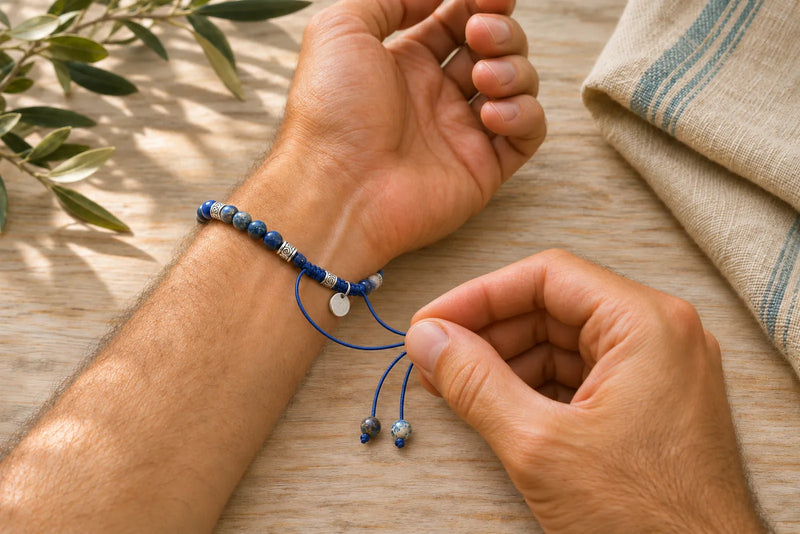
- Leave enough cord at both ends to hold and tie. Follow the cord maker's preparation instructions. For example, Beadalon recommends gently stretching its jewelry elastic before stringing.
- Place a bead stopper near one end, then slide on the beads in the order on your mat. Check the last gap with both ends held together and change the count if needed.
- Tie the knot recommended for your elastic. If the maker specifies adhesive, use a compatible one and let it dry as directed before trimming the tails. If an end bead has room for the knot, slide the bead over it once the knot is secure.
When you're ready to make a band with rows of beads, follow a floral square-stitch chart. It shows how the thread connects one row to the next.
Beaded bracelet pattern FAQs
Can I use smaller beads with the same pattern?
Yes. Keep the color order and measure one full repeat with the new beads. A five-bead repeat in 3 mm beads takes up about 15 mm, so eight repeats give about 120 mm of beadwork. Add whole repeats where you can, then check the fit. If you’re switching from rounds to discs, start with patterns for flat clay discs and check the length with your own beads.
Can I mix glass and stone beads?
Yes. For the closest match to these counts, use glass and stone rounds with similar widths. Check the fit of the elastic through both materials, especially if you add a smaller spacer or choose to tuck the knot inside a bead. Measure a laid-out repeat if the beads have different widths.

Save 20%
Coordinated pieces, ready to wear.

Up to 15%
Pick any 3 or 5 bracelets.
From a customer
★★★★★
“Still wearing it two months later.”
Nick Verified · Sicily set


