


Fabric bracelets are wrist accessories made from textile strips, thread, cord, or elastic fabric. Some are braided, others are knotted or sewn into a band. The name describes a broad family of bracelets, so the material, construction, and fastening matter more than the label alone.
For a finished thread design, Maresi's braided thread styles with sliding closures offer a starting point. BRUNUS WOVEN BRACELET combines brown and orange waxed cotton thread with an adjustable fit. Those warm colors would sit comfortably beside olive clothing or a plain cream shirt.

BRUNUS WOVEN BRACELET
What kind of fabric bracelet are you looking at?
A strip cut from a shirt and a bracelet worked from individual threads can look quite different on the wrist. Both may appear in a search for fabric bracelets.
| Type | How it is built | What to check |
|---|---|---|
| Fabric-strip bracelet | Cut strips are tied, braided, or combined with beads | Raw edges, fabric thickness, and the finish at each end |
| Woven or braided thread bracelet | Threads or cords form the band | Pattern, width, knot condition, and adjustment range |
| Sewn fabric band | Fabric is folded and stitched, sometimes with interfacing inside | Seams, backing, and the clasp or snap |
| Elastic textile band | Stretch fabric forms a continuous or joined band | Size, seam position, and how it feels when stretched over the hand |
| Fabric-wrapped bangle | Fabric covers a rigid bracelet base | The base size, exposed edges, and how the wrapping is secured |
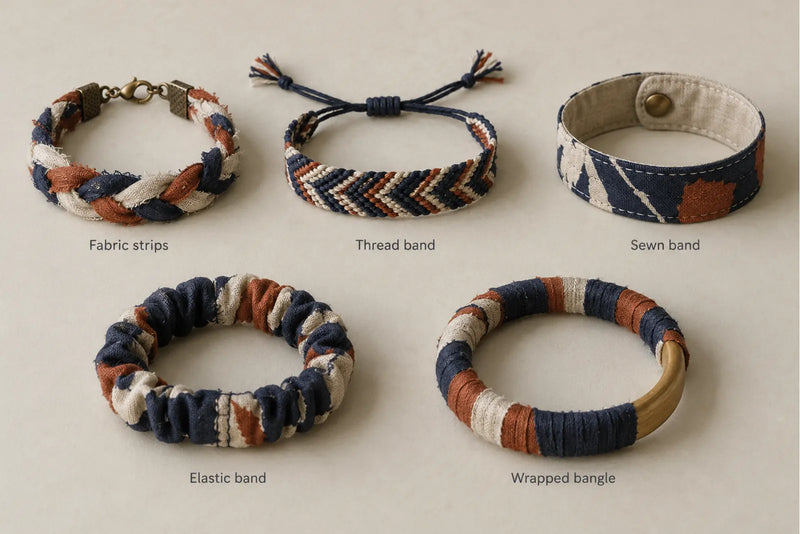
Cotton is a fiber; braiding is a way of arranging strands. Macrame describes knotting. None of those words, used alone, tells you everything about the finished piece.
Read the actual material description. A soft-looking surface does not establish that a bracelet is cotton, and a sliding closure does not mean it contains elastic. With handmade fabric bracelets, inspect the seams or end fittings as carefully as the decorative pattern.
Choosing fabric bracelets for men
Start with the clothes you wear most. Navy, gray, brown, and cream are straightforward choices alongside denim, cotton shirts, or knitwear. A brighter bracelet can work just as well when its color appears elsewhere in the outfit.
Width changes the effect. A narrow thread bracelet leaves more wrist visible; a broad fabric cuff becomes a larger part of the outfit. If you usually wear a watch, consider whether the bracelet will crowd its case or catch beneath the strap.
Then check the fastening:
- A sliding closure needs a stated adjustment range and enough room to pass over your hand when opened.
- A clasp adds length to the fabric band. Include the hardware when checking the finished measurement.
- A stretch band needs the right size even though it expands.
- A tied bracelet needs enough spare material for a secure fastening.
For men's fabric bracelets, an adjustable closure can be useful, but it does not make one size suitable for everyone. Check the individual measurements and choose a fit that lets you move your wrist freely.
Fabric bracelet patterns: prints, braids, and knots
The word "pattern" can mean the print on the cloth or the structure of the bracelet.
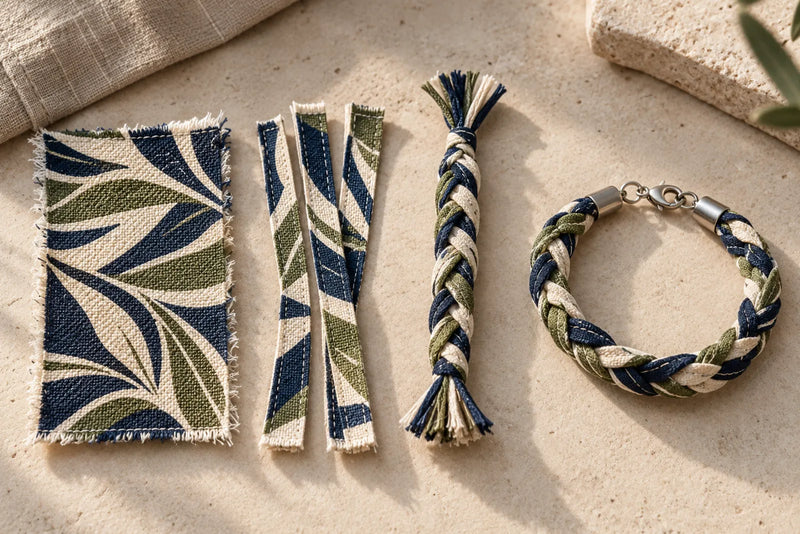
A striped fabric may produce broken bands of color once it is braided. A tiny floral print may read mainly as a mix of colors at a distance. For a quieter result, try similar shades; use contrasting strips when you want the braid itself to show.
Braided fabric bracelets use strips that cross over one another. A sewn cuff can display a larger uninterrupted print. Knotted thread bracelets build their motifs row by row, which is a different process again.
If you want chevrons, diamonds, or zigzags made with individual threads, compare motifs formed by rows of knots. You do not need to reproduce that technique to make a fabric-strip bracelet.
AZZURRI WOVEN BRACELET uses navy, white, and gold threads with a sliding closure. It is an example of color arranged within a thread pattern, rather than a printed fabric cut into strips. A navy shirt would keep the overall combination restrained.

AZZURRI WOVEN BRACELET
How to make fabric bracelets with a simple braid
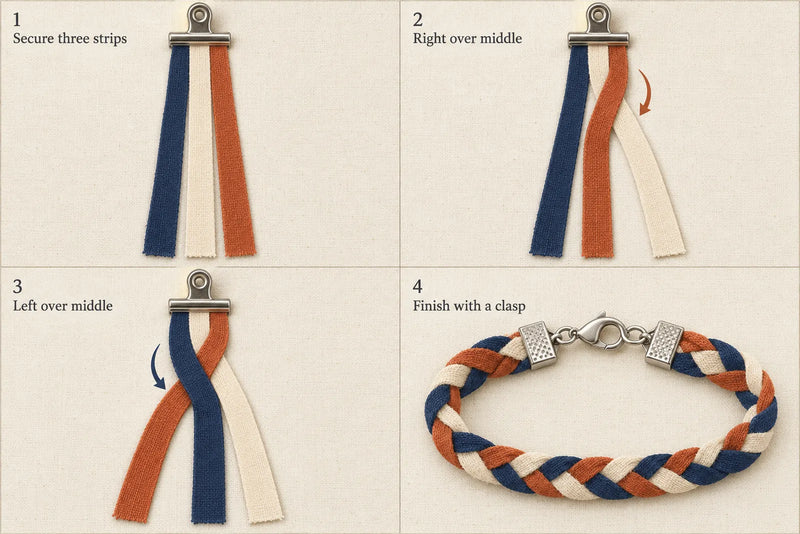
For a first fabric project, try a three-strip braid. This gives you a clear structure to practice before adding beads or learning a more involved weave. The steps below use raw-edge fabric strips and a clasp finish.
Gather three fabric strips about 1/2 inch wide, scissors, a ruler, tape or a clip, and ribbon-end clamps sized to fit your finished braid. You will also need jewelry pliers, jump rings, and a clasp. Raw edges give this version a slightly frayed finish.
1. Prepare the strips
Use three strips of similar thickness. Cut them generously longer than the band you need, allowing for the braid, handling, and trimming. Exact length depends on your fabric and braid tension, so make a short sample before cutting fabric you want to keep.
2. Hold the top and begin braiding
Align the strips and hold their upper ends together with tape or a clip on a stable surface. Cross the right strip over the middle strip. Cross the left strip over the new middle strip. Keep alternating sides.
Lay the strips flat as you work. Use steady tension rather than pulling hard; compare the width along the braid before continuing.
3. Check the length with the clasp included
Wrap the braid loosely around your wrist and allow for both end fittings, the jump rings, and the clasp. Stop before adding the hardware makes the bracelet too long. Keep the unfinished ends secured while you check.
4. Attach the end fittings
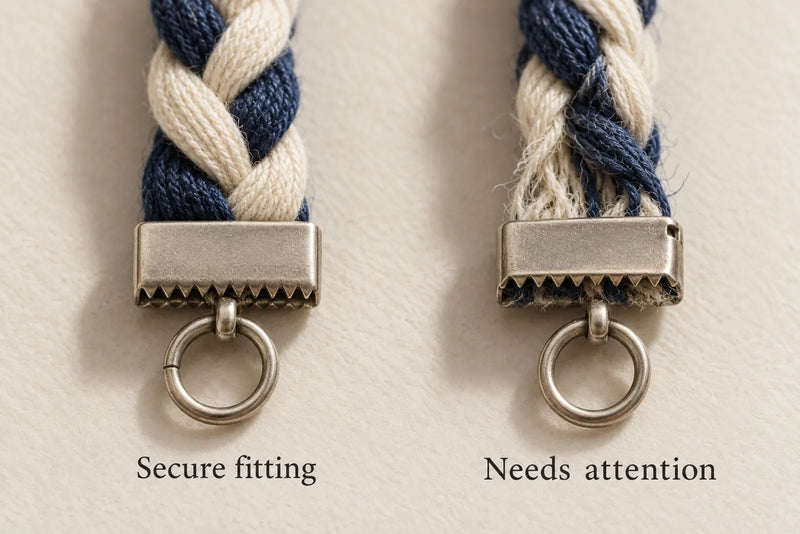
Fit one end of the braid into a ribbon-end clamp and close it firmly with jewelry pliers. Repeat at the other end, trimming only when you are sure of the length. Add the jump rings and clasp, closing each ring fully. Gently check that the fabric is held securely before wearing.
For a photographed example of a different braid and clasp finish, see HowJoyful's illustrated four-strand method. If you prefer working with individual strings, our beginner candy-stripe instructions in floss cover that separate technique.
Wearing a fabric bracelet with a watch or other jewelry
Try one fabric bracelet first. Leave enough space for your watch to sit normally, or wear the bracelet on the opposite wrist if the two keep rubbing together.
For a small stack, choose a shared color. A blue thread bracelet beside a plain metal piece will read differently from several wide patterned bands. Change one element at a time so you can see which combination you prefer.
RUBEUS WOVEN BRACELET has a blue base with red and white geometric details and an adjustable sliding knot. The patterned band provides a useful color reference: pick up its blue with denim, or let the red remain the only bright accent.

RUBEUS WOVEN BRACELET
Caring for fabric bracelets
Follow the instructions for the whole bracelet, including any metal, beads, coating, glue, or elastic. Fabric alone cannot tell you whether the finished item can be washed.
For Maresi's woven styles, remove the bracelet before swimming, showering, or exercising. Wipe it gently with a soft, dry cloth, avoid repeated pulling, and store it dry.
Before putting it on again, look at the areas that take the strain: the sliding knot, the edge beneath a clamp, or the seam where a band joins. A loosening fitting or a thinning strand needs attention before the bracelet is worn again. Avoid tugging at loose threads to tidy the surface.
For a homemade piece, keep a small offcut. If cleaning is needed, it gives you somewhere to check your chosen cleaning method before using it on the finished bracelet. A successful fabric test still does not establish that its clasp, adhesive, or other components can tolerate the same treatment.
Fabric bracelet questions
Are fabric bracelets and friendship bracelets the same?
They can overlap. "Fabric" describes the material or construction, while "friendship bracelet" describes a bracelet chosen or exchanged as a sign of friendship. A fabric bracelet can be worn simply because you like its color or texture.
Can you add beads to a fabric bracelet?
Yes, if the bead holes accommodate the fabric. Test an offcut before cutting your strips, and allow for the beads when checking the fit. A bead that fits over one strip may not fit over a finished braid.
Do handmade fabric bracelets have to match exactly?
No. You can choose matching designs, share one color, or make different pieces for each wearer. For a pair, check both wrist measurements rather than assuming the same finished length will suit you both.

Save 20%
Coordinated pieces, ready to wear.

Up to 15%
Pick any 3 or 5 bracelets.
From a customer
★★★★★
“Still wearing it two months later.”
Nick Verified · Sicily set


