


Start with flat polymer clay beads and a pattern you can repeat. Eight charcoal discs and one pewter-tone spacer make a quiet everyday bracelet. Navy and muted teal give you a summer palette without white. If you have one glass bead you like, set it between two matching spacers and let the rest of the bracelet stay simple.
The Kavos Clay Bracelet in Maresi’s clay bracelet collection shows what a little metal can do. Its matte blue clay beads carry the color, and silver-tone spacers break up the blue in short intervals. You can borrow that balance with whichever colors you have on your table.

KAVOS CLAY BRACELET
Everyday clay bracelet ideas
| If you want… | Start with… |
|---|---|
| The simplest repeat | Sand and espresso |
| Summer colors without white | Lagoon without white |
| One detail to build around | Midnight glass center |
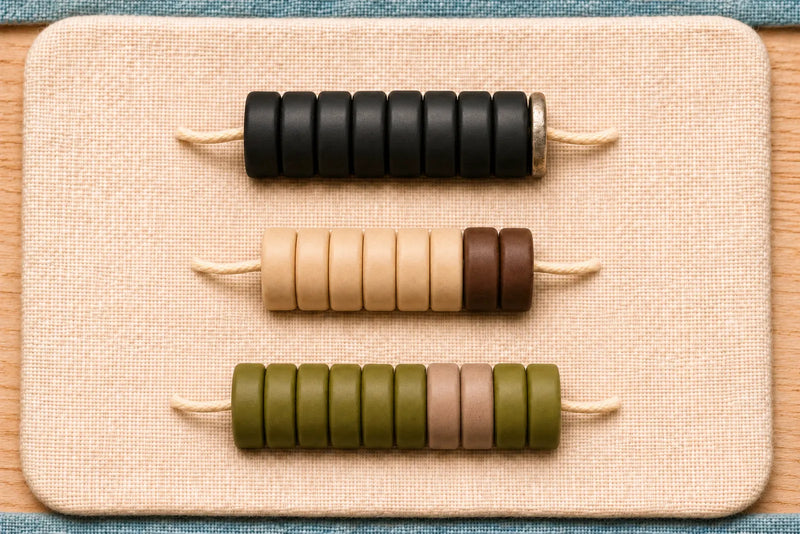
1. Charcoal and pewter
String eight charcoal discs, then one pewter-tone spacer. Repeat that group around the bracelet. A spacer close to the diameter of the clay discs will sit flush with the row, so the metal reads as a thin line. Try one repeat beside your watch before you commit to a full strand.
2. Sand and espresso
Repeat six sand discs and two espresso discs. Keep the sand beads together so the brown shows up as a short stripe. If the sand looks paler on your wrist than it did in the tray, swap it for a warmer tan and keep the same counts.
3. Olive bars
Lay out six olive discs, two taupe, then two olive. When two repeats meet, the olive discs join into a longer run. That extra space makes the taupe bars easy to pick out. For a softer version, use two colors with a similar depth, such as olive and warm gray.
4. Two-tone slate
Use ten slate discs followed by three in smoke blue. Keep the two colors close enough that the short blue blocks show up best in daylight. If your slate and blue discs differ in thickness, lay out the repeat before threading and judge the stripe by its width.
Summer clay bead bracelet ideas
5. Lagoon without white
Thread six navy discs, three muted teal discs and one bronze-tone spacer. Keep the spacer next to teal each time, where the metal gives the two cool blues a warm break. If the teal in your kit is bright, try a repeat on your wrist before choosing how much to use.
6. Sea glass
Repeat two ocean-blue discs, two sage and one pale gray. That short run of gray gives the eye a break between the stronger colors. Lay the pattern out next to the shirt or shorts you wear most in summer. A dusty sage works well beside faded denim.
7. Terracotta sunset
Stack six rust discs, four apricot and two ochre. Repeat the same sequence to give each warm block a clean edge. If you want a softer transition, lay out a second strip with the ochre moved between two apricot groups and see which rhythm you prefer.
8. Coastal signal stripe
Start with twelve ocean-blue discs, then add two coral. Keep the blue runs long enough for coral to read as a narrow stripe. Put any partial repeat on the underside of your wrist so the stripes across the top stay evenly spaced.
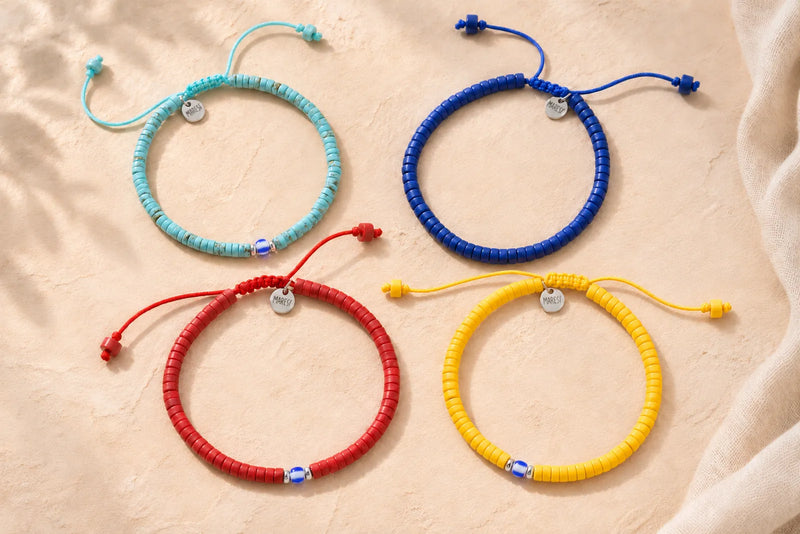
The Callais & Santorini Clay Bracelet uses turquoise clay discs as its base. A single glass Santorini accent stands out against the steady color.

CALLAIS & SANTORINI CLAY BRACELET
Clay bead bracelet patterns with one focal detail
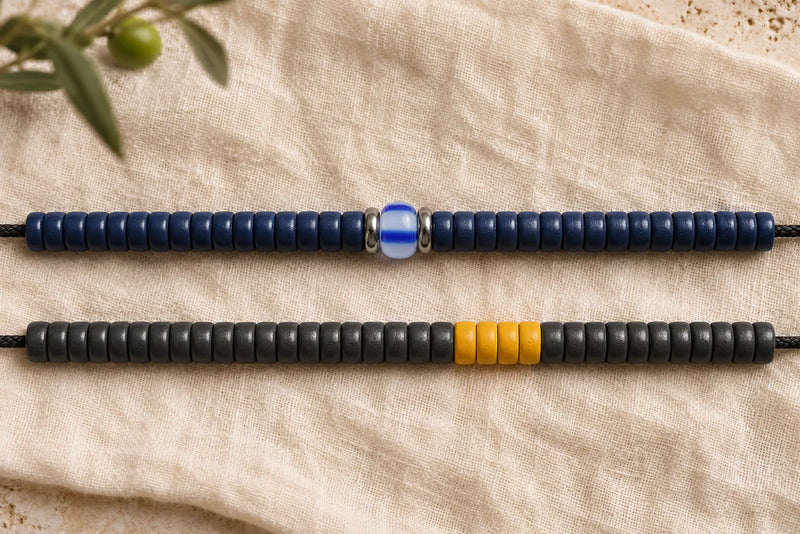
9. Midnight glass center
Set one blue glass bead at the center. Add one gunmetal-tone spacer and five ink-blue clay discs to each side, then fill out both ends with ink blue. A light, patterned glass bead will stand out against the dark clay even when the rest of the bracelet is in shadow.
10. Centered initial
Start with one letter bead face up. Frame it with a small metal spacer and four clay discs on each side, then carry the same base color out to the ends. Check the direction of the letter while the bracelet is on the table. A square letter bead can turn as it slides onto the cord.
11. Single metal bar
Put a short silver-tone tube between two dark gray discs of similar diameter. Fill both sides with matte gray discs. Try the tube against the top of your wrist before stringing the whole bracelet. A shorter bar leaves more room for the row of beads to curve around the wrist.
12. Offset ochre block
Mark the center of a charcoal layout, then place four ochre discs about an inch to one side. Fill the rest with charcoal. Hold the curved strand over your wrist and turn your hand. Slide the block closer to the middle if it disappears around the side.
How to lay out and size your bracelet
Measure around your bare wrist where the bracelet will sit. A snug strip of paper and a ruler work if you do not have a soft tape. Use Maresi’s bracelet sizing guide for the measuring method. Leave room for the fit you prefer and check that a stretch loop can pass over the widest part of your hand.
To estimate the bead count, count how many of your flat discs fill one inch when stacked face to face. The thickness of each disc determines how much length it adds along the cord. If your layout is 7.5 inches long and the accents take up half an inch, seven inches remain for clay. At 22 discs per inch, that is about 154 discs.
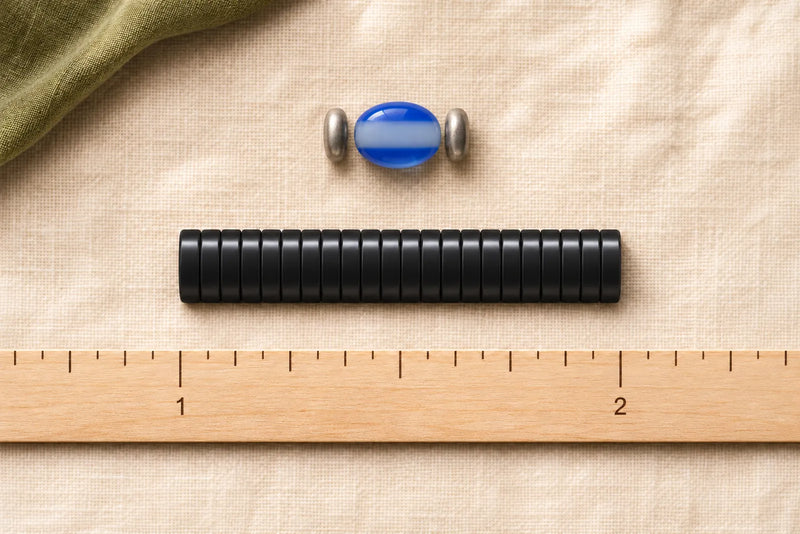
The Mavros & Santorini Clay Bracelet gives you a reason to measure the accent separately. Its blue glass focal bead sits among matte black clay discs. Lay out the glass and both spacers first when you try a similar arrangement, then measure the space left for your clay.

MAVROS & SANTORINI CLAY BRACELET
For a centered pattern, work outward on both sides and remove the same number of discs from each end when you shorten it. If you’re mixing discs of different thicknesses, measure a whole repeat in the order you plan to string it. A repeat that takes up half an inch fits fifteen times into a 7.5-inch layout. If there’s room left after the last full repeat, fill the space near the knot with the base color.
How to string a clay bracelet
Choose stretch cord that passes through the smallest hole in your pattern. Test the focal bead and spacers too. Set out the beads on a mat, leave enough cord to hold while tying, and keep the first end clipped so the discs stay in place.
Follow the cord maker’s instructions for stretching and tying. Hold the threaded ends together to check the fit before fastening the knot, then test the finished loop gently before trimming the tails. If you switch to adjustable cord, Maresi’s guide to sliding knots for clay bead bracelets shows the closure options.
Clay bracelet questions
Do I need to bake clay beads from a bracelet kit?
If the kit contains finished, cured beads, you can string them as supplied. If you make beads from raw polymer clay, follow the curing directions on the package before assembly.

Save 20%
Coordinated pieces, ready to wear.

Up to 15%
Pick any 3 or 5 bracelets.
From a customer
★★★★★
“Still wearing it two months later.”
Nick Verified · Sicily set


