


Carat measures the weight of a diamond or other gemstone. Karat measures the purity of gold on a scale of 24. That is the main difference between carat and karat: a 1-carat diamond weighs 0.2 grams, while 18-karat gold contains 75% gold. A single piece of jewelry can carry both descriptions because they tell you about different materials.
On a bracelet, you may also see millimeters, grams or a 925 mark. Each answers a different question. Maresi's collection of stone bracelets with clearly listed bead materials is a useful place to see how dimensions and material descriptions work together.
The Tiger Eye Bracelet, for example, uses natural 4 mm beads on an adjustable cord. Those millimeters describe the beads' diameter. They help you picture the bracelet's proportions without needing a carat figure.

TIGER EYE BRACELET
Carat and karat at a glance
| Term | What it measures | Common abbreviation | Example |
|---|---|---|---|
| Carat | Gemstone weight | ct | A 0.50 ct stone weighs 0.10 grams |
| Karat | Gold purity | K or kt | 18K gold contains 18 parts gold out of 24 |
| Millimeter | Physical dimensions | mm | A 4 mm round bead is 4 mm across |
| Gram | Weight | g | A bracelet's weight may include several materials |
If a description says "a 0.50 ct diamond in 18K gold," the first number concerns the stone and the second concerns its gold setting. Neither number gives you the total weight of the finished piece.
What is a carat?
One metric carat equals 200 milligrams, or 0.2 grams. It is a unit of weight used for diamonds and other gemstones. GIA's explanation of carat weight also divides one carat into 100 points, so a 25-point diamond weighs 0.25 carats.
A carat figure does not give a stone's diameter. Shape and proportions affect how much of it you see from above, and different gem materials have different densities. Two stones of the same carat weight can therefore have different dimensions.
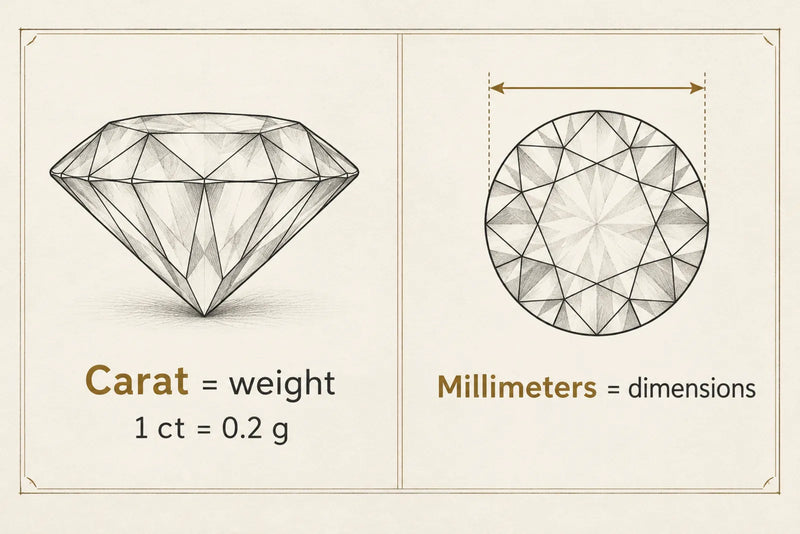
For jewelry you plan to wear, look at both measurements. Carats tell you how much the stone weighs; millimeters help you judge its physical size. A photograph on a hand or wrist adds context, especially when the description identifies the size being shown.
Single-stone weight and total carat weight
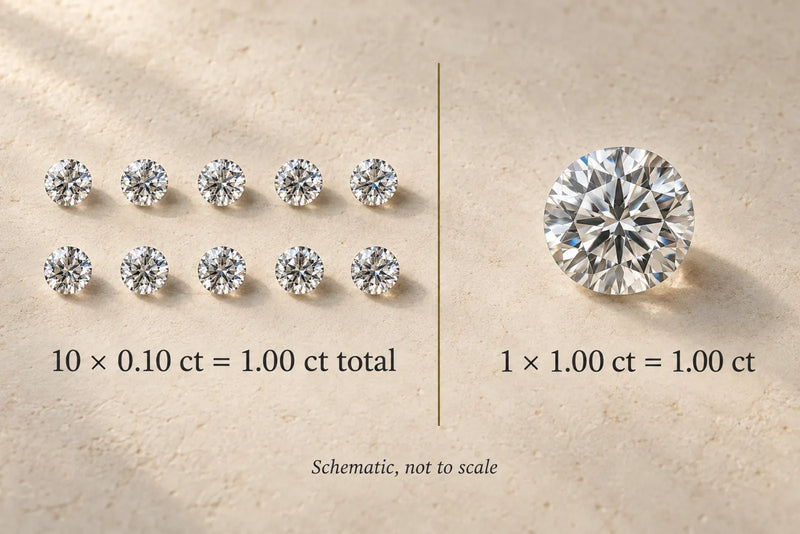
On a diamond bracelet or a pair of earrings, watch for "total carat weight," often shortened to tcw or ctw. It adds together the weights of the diamonds included in that description.
Ten diamonds weighing 0.10 carats each total 1.00 carat. That does not mean the jewelry contains a single 1-carat diamond. When comparing pieces, check how many stones share the stated weight and whether a center stone is listed separately.
What is a karat?
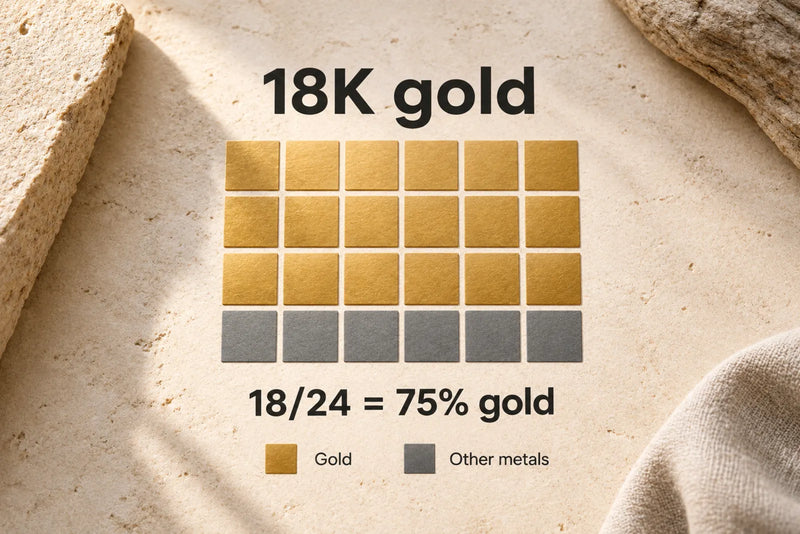
A karat describes the proportion of gold in a gold alloy. The scale has 24 parts: 18K means 18 parts gold and six parts other metals. To turn a karat number into a percentage, divide it by 24 and multiply by 100.
| Gold grade | Gold content by the 24-part calculation |
|---|---|
| 10K | About 41.7% |
| 14K | About 58.3% |
| 18K | 75% |
| 22K | About 91.7% |
| 24K | Pure gold grade; commercial fineness may be stated as 999 or 999.9 |
You may see 585 for 14K gold and 750 for 18K. These express fineness in parts per thousand. Although 14 divided by 24 is about 58.3%, the common 585 mark represents 58.5%. The World Gold Council explains this convention in its reference on gold purity and fineness.
Silver uses its own composition marks. The Kompos Silver Bracelet is a 925 sterling silver open cuff with a central knot detail. Its 925 description refers to silver content, not gold karats or gemstone carats.

KOMPOS SILVER BRACELET
Sterling silver contains 92.5% silver. If a listing calls it "925 karat silver," it is mixing two systems. Our guide explains how to read a 925 silver mark and why the mark alone cannot establish authenticity.
Carat or karat: which spelling is correct?
For diamonds, use carat, with a C. "Two-karat diamond" mixes a gemstone's weight with the spelling used for gold purity in American English.
Gold has a spelling exception worth knowing. US jewelry descriptions generally use karat, while British English commonly uses carat for gold purity too. An "18-carat gold bracelet" can therefore be correctly described. Merriam-Webster recognizes these accepted spellings for gold purity.
Read the material beside the number. In "18-carat gold," the number describes gold purity. In "1-carat diamond," it describes gemstone weight. The shared spelling in some markets does not make the measurements interchangeable.
What these numbers leave out
Neither carat nor karat tells you everything about a piece of jewelry. Gold purity does not describe the thickness of a cuff, and a diamond's weight does not tell you its cut, color or clarity.
Read any words following a gold grade, too. "18K gold-plated" describes a gold layer over another material. It does not mean the whole piece is an 18K gold alloy. Ask what lies underneath and which components the description covers.
Material identity matters just as much for beads. A weight or dimension cannot establish whether a bead is a natural stone or a manufactured material. That information needs to be stated separately.
The Blue Sandstone Bracelet Silver makes that distinction clear: its 4 mm blue beads are manufactured glass, while its spacers and MARESI tag are sterling silver. The bead dimensions, bead material and metal composition describe separate parts of the same bracelet.

BLUE SANDSTONE BRACELET SILVER
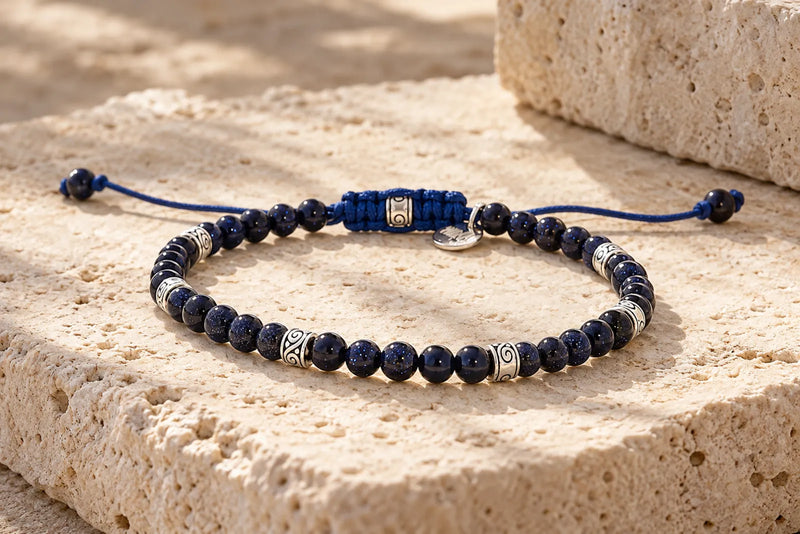
Despite its name, blue sandstone is also called blue goldstone. Our explanation of why blue sandstone is glass covers the material behind its reflective flecks. A gold-sounding name does not give it a gold purity grade.
How to read a jewelry description
Start with the material, then attach each number to the part it describes:
- Identify the stone or bead material. Look for a specific name and any statement that it is manufactured or treated.
- Check the dimensions. Millimeters help you judge bead diameter, cuff width or a stone's length and width.
- Read the metal description in full. Distinguish a gold alloy from a gold coating, and silver content from surface color.
- Check the scope of the weight. Is it one stone, all the diamonds, or the complete piece?
If a label leaves you guessing, ask the seller to put the material and measurements in writing. A clear description should let you understand what you are comparing before you decide whether you like the design.
FAQs
Can you convert karats into grams?
Not directly. Karat is a proportion; grams measure weight. If an item contains 8 grams of 18K gold alloy, that alloy contains 6 grams of gold by calculation. The example assumes the full 8 grams is the alloy, excluding stones and other components.
Why do carat and karat sound the same?
They share an etymological root associated with the carob seed and an old unit of weight. Their jewelry meanings developed differently. The similar sound survives, which is why the material named beside the number is so useful.

Save 20%
Coordinated pieces, ready to wear.

Up to 15%
Pick any 3 or 5 bracelets.
From a customer
★★★★★
“Still wearing it two months later.”
Nick Verified · Sicily set


