


The main bracelet types include bangles, cuffs, chain bracelets, beaded bracelets, tennis bracelets, charm bracelets, leather bracelets, and woven or friendship bracelets. These names can overlap: a leather bracelet may be braided, and a chain bracelet can carry charms.
Some names describe a material or finish within those families. Stone, seed bead, Picasso bead, clay bead, and pearl bracelets are types of beaded bracelets. Sterling silver describes the metal, while a bracelet stack is several separate pieces worn together. For thread-based designs, see chevron, diamond, wave, and braid patterns.
To compare finished bracelet designs, explore men's bracelet collection.
Once the style is clear, you can choose a bracelet for the memory behind it, whether that connection is a person, place, or milestone.
These overlapping names can make bracelet shopping more confusing than it needs to be. A bangle and a cuff may both be metal, but they do not fit the same way. Stone and seed bead bracelets are both beaded, yet they have completely different weight and presence on the wrist. These differences are visible across Maresi's men's bracelet collection, which includes stone, woven, beaded, cuff, silver, and stacked styles.
This guide breaks down the names of bracelets you are likely to encounter, with extra attention given to the materials and styles found in Maresi's men's collections.
What are bracelets? They are pieces of jewelry worn around the wrist. Their material, structure, and closure determine how they fit and look.
Men's bracelet styles at a glance
Start with the clothes and watch you wear most days. These five choices make it easier to narrow down the styles in the full comparison below.
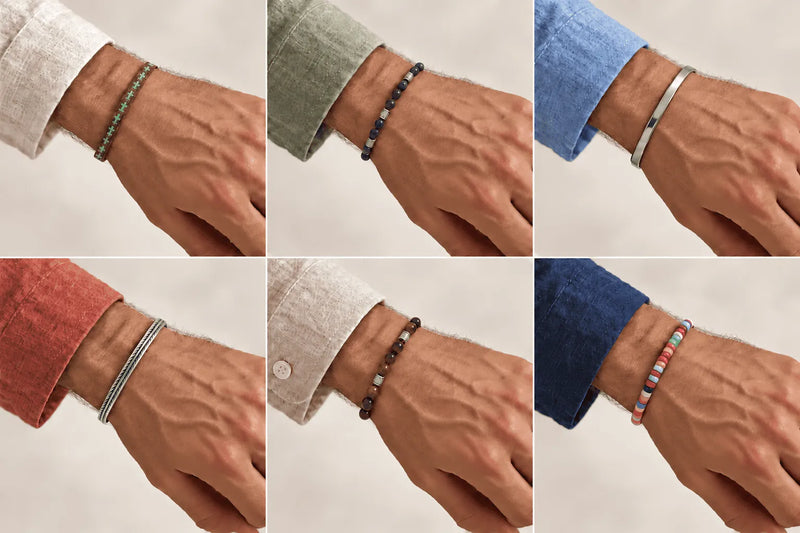
- Quiet everyday look: A slim seed bead or woven bracelet adds detail without dominating a T-shirt, shirt, or watch.
- Casual color: Stone, clay, and friendship bracelets work with denim, linen, and relaxed shirts.
- Cleaner, smarter look: A narrow silver bracelet or simple cuff keeps the wrist more structured.
- Beside a watch: Try a slim seed bead or woven piece. A wide cuff or larger stone bracelet usually has more room on the other wrist.
- Layered look: Start with one stone bracelet or cuff, then add one slimmer piece that shares a color.
There is no single best bracelet style. The right one depends on your clothes, your watch, your wrist size, and how noticeable you want the bracelet to be.
Names of bracelets at a glance
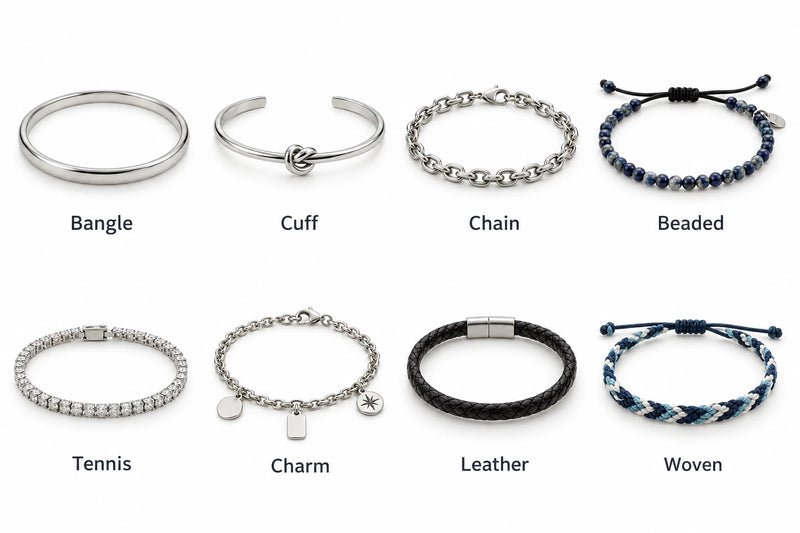
The 14 styles below include broad families, bead subtypes, a metal, and a way of wearing bracelets. The category column shows how each name fits.
| Bracelet name | Category | What defines it | How it looks |
|---|---|---|---|
| Stone bracelet | Beaded subtype | Stone beads | Textured and grounded |
| Seed bead bracelet | Beaded subtype | Small glass beads | Slim and colorful |
| Picasso bead bracelet | Beaded subtype | Glass beads with a mottled finish | Weathered and detailed |
| Clay bead bracelet | Beaded subtype | Shaped clay elements | Matte and relaxed |
| Woven bracelet | Construction | Interlaced thread or beads | Soft and patterned |
| Friendship bracelet | Meaning; often woven or knotted | Usually braided or knotted thread | Personal and informal |
| Bangle | Shape | Rigid circular or open shape | Clean and structured |
| Cuff | Shape | Rigid band with an opening | Structured; narrow or wide |
| Chain bracelet | Construction | Connected metal links | Polished and flexible |
| Leather bracelet | Material | Flat or braided leather | Rugged and casual |
| Sterling silver bracelet | Material | Sterling silver construction or details | Cool and refined |
| Charm bracelet | Design | Small hanging elements on a base | Personal and decorative |
| Tennis bracelet | Design and construction | Continuous row of set gemstones | Fine and polished |
| Stacked bracelets | Arrangement | Several separate bracelets worn together | Layered and expressive |
Types of beaded bracelets
Beaded bracelets are not one single style. Bead material, size, color, and finish all change how the bracelet looks on a man's wrist. You can compare beaded bracelet styles for men across stone, seed-bead, glass, and clay designs.
A 2 mm seed bead bracelet sits low and adds a small line of color. A 4 mm stone bracelet has more weight and can carry the whole look by itself. That difference matters more than the word "beaded" suggests.
Pearl bracelets also belong in the beaded family. Pearls may form the whole strand or appear between other beads. Their rounded shape and luster describe the material and look; the closure still determines how the bracelet goes on and fits.
1. Stone bracelets
Stone bracelets are made by threading natural or semi-precious stone beads onto an adjustable base. Each bead may have slight differences in color, pattern, or surface detail.
Dark stones work well with black, gray, navy, and denim. Blue or turquoise stones bring more color but still feel grounded because the material has natural variation. Mixed stones are more noticeable and usually work best as the main bracelet.
Maresi's stone bracelet styles for men use approximately 4 mm beads. That gives them enough presence to wear alone while keeping them easy to combine with slimmer pieces.
Best for men who like natural texture and want one bracelet that does not disappear on the wrist.
2. Seed bead bracelets
Seed bead bracelets use small glass beads arranged closely along the wrist. Their narrow profile makes them one of the easiest different bracelet styles to wear beside a watch.
Maresi uses 2 mm Miyuki glass beads in its seed bracelets. They add color without taking over the outfit. A black seed bracelet can be almost invisible from a distance, while turquoise, blue, or multicolor beads become a deliberate accent.
If you're wondering whether the color carries any significance, we also explain black beaded bracelet meaning and why the material and context matter more than the color alone.
The seed bead and Picasso bracelet styles include both clean, uniform colors and more textured bead finishes.
Best for men who want a lightweight bracelet or a slim supporting piece in a stack.

INDIGO SEA SEDIMENT JASPER
3. Picasso bead bracelets
Picasso beads are glass beads with an irregular, mottled finish. They have the same compact size as many seed beads, but their surface looks less uniform.
That variation gives the bracelet more depth without making it physically larger. A dark Picasso bracelet can sit quietly beside a stone piece, while blue or earth-toned versions bring in color that does not look too polished.
Best for men who like slim bracelets but find plain glass beads a little too clean.
4. Clay bead bracelets
Clay bead bracelets have a softer and more matte appearance than glass, stone, or metal. The beads may be smooth, patterned, neutral, or brightly colored.
Clay works particularly well with natural stone and woven thread. The materials have different surfaces, so the combination feels layered even when the colors are similar.
Best for relaxed outfits, warm colors, and men who prefer handcrafted materials over polished jewelry.
Different styles of bracelets made with thread
Thread-based bracelets sit close to the wrist and move naturally with the hand. They are usually lighter than stone or metal, which makes them comfortable for long days, travel, and warm weather.
5. Woven bracelets
Woven bracelets are made by interlacing threads, fibers, or small beads into a flat or rounded band. The pattern becomes the main feature.
They add texture without much weight. A woven bracelet, including nautical rope styles, can be useful when a stone bracelet feels too heavy or a silver bracelet feels too formal.
Maresi's woven bracelet styles for men work naturally with linen, cotton, denim, and rolled sleeves. They can hold their own, but they are especially useful for breaking up a stack made mostly from round beads.
Best for casual clothes, summer outfits, and adding pattern to the wrist.
6. Friendship bracelets
Friendship bracelets are usually braided, woven, or knotted from colored thread. The name describes what the bracelet represents rather than one exact construction. A flat square-knot bracelet is one example of a knotted construction.
Different friendship bracelet string types suit different constructions, from knotted floss patterns to cord designs.
Traditional friendship bracelets are simple and handmade. Men's versions may include small metal details, beads, or adjustable closures while keeping the same relaxed character.
They are easy bracelet gift ideas for men because the meaning does not depend on precious materials. The value comes from the connection, the color, or the memory attached to the piece.
If you are choosing a pair, these matching best friend bracelets show how to coordinate color, material, and fit for two people.
Best for personal gifts and casual daily wear. If you are shopping on a fixed budget, compare small bracelet gifts under $25.
Bracelet shapes that change the whole look
Bracelet shapes affect how a piece fits and moves. Color gets most of the attention, but shape is usually what determines whether a bracelet feels subtle, sharp, relaxed, or heavy.
7. Bangle bracelets
A bangle is a rigid bracelet that keeps its shape after you remove it. Traditional bangles form a complete circle and slide over the hand. Open bangles have a gap that makes them easier to put on and adjust.
Maresi's men's bangle bracelet styles use an open-back design and measure approximately 4 mm wide. They bring a clean metal line into a stack without the size of a wide cuff.
A single bangle looks sharp beside a watch. In a mixed stack, it creates contrast against stone, clay, and woven textures.
Best for men who want a simple metal bracelet without chain links.
8. Cuff bracelets
A cuff is a rigid or semi-rigid band with an opening on one side. It slips over the narrow part of the wrist rather than over the hand.
Cuffs can be narrow and understated or wide enough to become the main accessory. Wider designs have more presence and need more empty space around them. Piling several bracelets beside a large cuff usually makes the wrist look crowded.
The easiest way to remember the difference is simple: a traditional bangle forms a circle, while a cuff has an opening and usually covers more of the wrist.
Best for men who want one strong, structured piece.

ARBUSTO WOVEN BRACELET
Metal and leather bracelet styles
Metal and leather sit at opposite ends of men's bracelet styling. Metal looks cleaner and more polished. Leather feels warmer and more rugged.
9. Chain bracelets
Chain bracelets are made from connected metal links. Common names include cable, curb, rope, box, Figaro, paperclip, and Cuban link bracelets.
The link size controls the volume. Fine links add a small flash of metal. Wide curb or Cuban links have real weight and usually work better alone.
If you wear a chain bracelet beside a watch, keep the bracelet narrower than the watch case. Two large metal pieces competing on the same wrist rarely improve each other.
Best for smart-casual clothes and men who prefer flexible metal over a rigid bangle.
10. Leather bracelets
Leather bracelets can be flat, braided, wrapped, or combined with a metal clasp. Brown leather has a warmer, more traditional look. Black leather feels cleaner and more modern.
Leather works well with denim, boots, workwear, and earth tones. It can also soften the look of a metal watch. A narrow braided piece is easier to combine than a large leather cuff.
Best for casual outfits and men who want something less polished than silver.
11. Sterling silver bracelets
Sterling silver bracelets may be made primarily from silver or combine silver details with stone, glass, clay, or woven elements.
Silver looks especially natural with black, gray, blue, white, and turquoise. It also makes sense for men who already wear a watch or ring with a silver-tone finish.
Maresi's sterling silver bracelet styles apply sterling silver across several designs. That lets you choose the material without being locked into one shape.
Best for cleaner outfits and men who want metal details without a heavy chain.
Bracelet names based on design
Some bracelet names have less to do with the base material and more to do with the way the design is assembled.
12. Charm bracelets
Charm bracelets carry small decorative elements attached to a chain, band, or beaded base. The charms may represent places, symbols, interests, or events.
The style can become busy quickly, especially when several large charms sit on the same wrist. Men's charm bracelets usually look stronger with fewer elements and a tighter color palette.
Best for men who want the bracelet to carry a personal reference.
13. Tennis bracelets
A tennis bracelet uses a continuous line of closely set diamonds or other gemstones. The connected settings let the bracelet bend naturally around the wrist.
The design is associated with fine jewelry, but the shape itself is simple. A narrow tennis bracelet can work with a suit, knitwear, or a clean T-shirt because there are no hanging parts or oversized links.
It is more polished than the other types in this guide, so it usually looks better alone or beside one understated metal piece.
Best for formal clothing and men who want a fine-jewelry bracelet.

KOMPOS BRACELET
14. Stacked bracelets
Stacked bracelets are several separate bracelets worn together as one composition. The best stacks look collected, not crowded.
A wrap bracelet is different: one long bracelet goes around the wrist two or more times. A wrap can create a layered look with one piece, while a stack lets you remove or rearrange separate bracelets. Check the intended number of wraps and the bracelet's finished length before choosing a size.
Start with one anchor piece. This is usually a stone bracelet, bangle, or another design with noticeable weight. Add one slimmer bracelet and one contrasting texture. Three pieces are enough for most wrists.
For example, combine a 4 mm stone bracelet with a 2 mm seed bead bracelet and a narrow woven piece. The sizes are different, but a repeated color keeps them connected.
Maresi's different bracelet styles in one stack mix stone, seed bead, clay, woven, and metal elements. You can wear the complete set or pull out one or two pieces on quieter days.
Best for men who want more color and texture without choosing every bracelet separately.
How bracelet shape changes the fit
Check both the shape and the closure. Two beaded bracelets can fit differently if one has a sliding knot and the other has a fixed clasp.
| Shape and examples | Closure | How it goes on | How it sits | What to measure |
|---|---|---|---|---|
| Flexible strand: stone or seed bead | Adjustable cord / sliding knot | Loosen the loop over the hand, then adjust at the wrist | Follows the wrist with adjustable room | Wrist circumference and the listed adjustment range |
| Flexible strand: elastic beaded bracelet | Stretch elastic | Stretch gently over the hand | Follows the wrist; size depends on the elastic strand | Wrist circumference and the listed bracelet size |
| Flat band: woven or friendship bracelet | Tied ends or an adjustable closure | Tie or adjust around the wrist, depending on the design | Sits close against the skin | Wrist circumference, band width, and the listed size range |
| Linked or fixed-length bracelet: chain, tennis, or clasped beads | Clasp | Open the clasp and fasten around the wrist | Bends around the wrist but has a fixed wearable length | Wrist circumference and the finished wearable length |
| Rigid circle: closed bangle | No opening | Slide over the hand | Keeps a fixed shape | Hand width or circumference at the knuckles and the listed inner diameter |
| Rigid circle: hinged bangle | Hinge and latch | Open the bangle and close around the wrist | Keeps a fixed shape | Wrist circumference and the listed inner dimensions |
| Open rigid band: cuff or open bangle | Open ends | Slip the gap over the narrow side of the wrist, then turn into position | Rests around the wrist with an opening | Wrist circumference, inner dimensions, and opening width |
| Layered arrangement: bracelet stack | Varies by piece | Put on each bracelet separately | Uses space across the wrist | Each bracelet's fit and the combined width of the stack |
Flexible bracelets are forgiving because they follow the wrist. Rigid pieces need more attention to size and opening width. A bracelet can look right in a product photo and still feel wrong if its shape does not suit how you move your hands.
What changes the style of bracelets?
Five details make the biggest difference:
- Material: Stone, glass, clay, thread, leather, or metal
- Shape: Flexible strand, flat band, chain, closed circle, or open cuff
- Width: Slim bracelets are quieter, while wider pieces hold more attention
- Finish: Matte, polished, hammered, woven, or mottled
- Color: Neutral colors blend into an outfit, while brighter colors act as accents
Material sets the general mood. Shape determines how the bracelet sits. Width decides how loudly it speaks.
That is why two black bracelets can still look completely different. A 2 mm black seed bracelet is subtle. A wide black leather cuff is not.
How to choose a bracelet you will actually wear
Knowing the category is only the first step. This guide shows how to wear different bracelet styles with everyday clothes, a watch, or a small coordinated stack.
Start with your normal clothes
Buy for the clothes already in your closet.
Stone, clay, and woven bracelets work well with T-shirts, denim, linen, and casual button-down shirts. Bangles and silver pieces suit cleaner outfits. Leather fits naturally with workwear and heavier fabrics.
A bracelet that needs a completely different wardrobe will probably spend most of its time in a drawer.
Look at your watch
Your watch is already the largest object on your wrist. Treat it as part of the decision.
A slim seed bead or woven bracelet can sit beside most watches. A large chain or cuff may need the opposite wrist. If the watch has a silver-tone case, repeating a small amount of silver elsewhere makes the combination feel deliberate.
Pay attention to width
A few millimeters make a visible difference.
Maresi seed bead bracelets are approximately 2 mm wide. Stone, woven, friendship, and bangle styles are closer to 4 mm. A 2 mm bracelet supports the outfit. A 4 mm bracelet is more likely to become part of the outfit.
Get the fit right
A bracelet should move slightly without falling over the hand. You should usually be able to place one finger between the bracelet and your wrist.
Maresi's adjustable cord styles generally fit wrists from 16 to 24 cm, or about 6.3 to 9.4 inches. Check the individual product's size information before buying. This cord adjustment range does not describe cuff or bangle sizing; use their listed inner dimensions and opening width instead.
Do not build the entire stack at once
Wear one bracelet first. Notice where it sits, how it feels beside your watch, and whether you keep adjusting it.
Then add a second texture. Stop when the stack feels finished. There is no prize for using every bracelet you own on the same wrist.

CAPRI BRACELET SET
Frequently asked questions
What are the main types of bracelets for men?
The main bracelet families include bangles, cuffs, chains, beaded bracelets, tennis bracelets, charm bracelets, leather bracelets, and woven or friendship bracelets. Stone, seed bead, Picasso bead, clay bead, and pearl are beaded subtypes. Silver describes a material, while stacking describes wearing several bracelets together.
What are the different types of beaded bracelets?
Common types of beads used in bracelets include natural stone, seed bead, Picasso bead, clay, glass, wood, metal, crystal, and pearl beads. Stone beads have more weight and texture, while seed beads create a slimmer bracelet that is easier to layer.
What is the difference between a bangle and a cuff?
A traditional bangle forms a rigid circle and usually slides over the hand. A cuff has an opening that slips over the side of the wrist. Open bangles sit between the two styles because they keep a narrow bangle shape but use an open construction.
Which bracelet style is best for everyday wear?
Stone, seed bead, woven, bangle, and simple silver bracelets all work well for everyday wear. The best choice depends on your clothes and how much visual weight you want. Seed beads are subtle, while stone and metal pieces are easier to notice.
Can men wear several different bracelet styles together?
Yes. Start with one anchor bracelet, then add one or two slimmer pieces in different textures. Repeat one color or metal finish across the stack. Three coordinated bracelets usually look more intentional than five unrelated ones.
Should a man wear bracelets on the same wrist as his watch?
A slim bracelet can sit beside a watch if it does not scratch the case or crowd the wrist. Wider cuffs, heavy chains, and larger stone bracelets often look better on the opposite wrist. Comfort matters more than following a fixed rule.
Which bracelet belongs on your wrist?
Understanding the different types of bracelets makes the choice much simpler. Stone offers natural texture. Seed beads add quiet color. Woven bracelets feel relaxed. Bangles and silver bring a cleaner edge. Stacks combine those qualities when one bracelet is not enough.
Start with the style that fits the clothes you already wear. Once that piece feels natural, you will know what to add next. You can explore men's bracelet styles by material, color, or complete set.

Save 20%
Coordinated pieces, ready to wear.

Up to 15%
Pick any 3 or 5 bracelets.
From a customer
★★★★★
“Still wearing it two months later.”
Nick Verified · Sicily set


