


Picture jasper is an opaque, patterned variety of jasper whose earthy bands and markings can resemble hills, deserts or distant mountain ranges. A picture jasper stone gets its name from that scenic appearance, rather than from a separate mineral species. The patterns in genuine material are natural, although the scenery you see in them is a matter of interpretation.
Like other jaspers, it is generally described as microcrystalline quartz or chalcedony. Mineral inclusions and differences in texture help explain why jasper looks so different from one piece to another.
Our natural jasper bead design shows how the same material can vary across a row of polished beads. For a larger, more continuous scene, collectors often look at flat slabs or cabochons.
Picture jasper properties at a glance
| Property | Typical description |
|---|---|
| Material family | Jasper, generally classed with microcrystalline quartz or chalcedony |
| Appearance | Scenic bands, patches and curved markings |
| Common colors | Tan, brown, cream and gray, with rust or darker markings |
| Transparency | Opaque |
| Hardness | About 6.5–7 on the Mohs scale |
| Common forms | Beads, cabochons, polished slabs and carvings |
The International Gem Society describes jasper's gemological properties and its use as a decorative stone. Hardness is a measure of scratch resistance: it does not mean a polished piece cannot chip or break.
Colors and landscape-like patterns
The familiar palette is warm and muted: cream beside tan, brown crossing gray, or a dark line running through a lighter area. A broad band may suggest a horizon; curved markings can look like hills or clouds. Turn the stone and the same pattern may suggest something else. For other pale materials, compare cream stones by color and pattern.
Cutting matters. A slab exposes a broad section through the material, while a small bead reveals only part of it. One bead may look almost plain beside another with clear bands. That variation alone is not a fault or proof of an imitation.
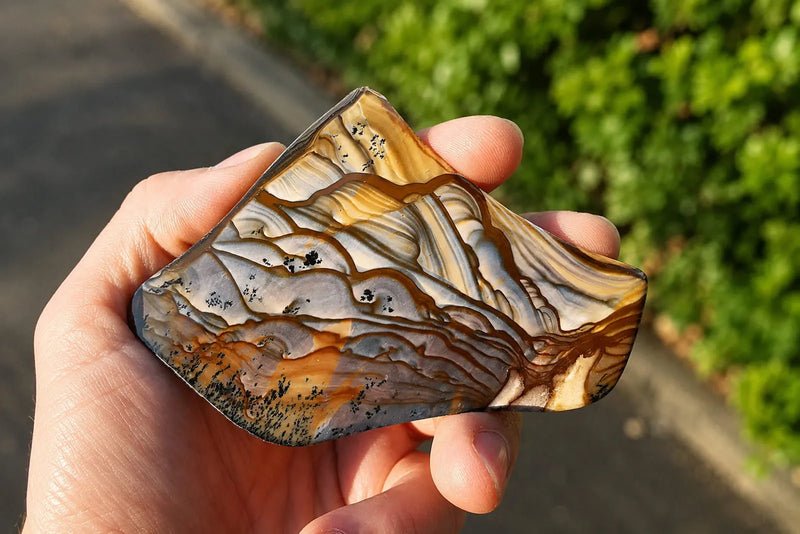
How does picture jasper form?
There is no single formation story that explains every stone sold under this descriptive name. Silica deposition or replacement, the surrounding rock and mineral coloring can produce different kinds of scenic material.
Near Biggs Junction in Oregon, geologists documented silicified sediment and related gem material between basalt flows. Their observations included fine-grained silicified ash or siltstone, jasper mixed with agate, and material retaining layers or broken fragments. These findings appear in the Oregon geological study of Biggs jasper.
Bruneau provides a useful contrast. Idaho State University's account of Bruneau jasper describes silica deposited in openings in rhyolite, a volcanic rock. The scenic effect is therefore not evidence that every piece began as the same kind of sediment. Nor is it a literal preserved photograph of an ancient landscape.
Where is picture jasper found?
Oregon and Idaho are well-known sources of named scenic jaspers. A broad label such as “landscape jasper” describes a look; a locality name makes a more specific claim about where the material came from.
| Name | Origin | Useful distinction |
|---|---|---|
| Biggs jasper | Biggs Junction area, Oregon | Documented silicified sediment and related material; layered or complex scenic textures |
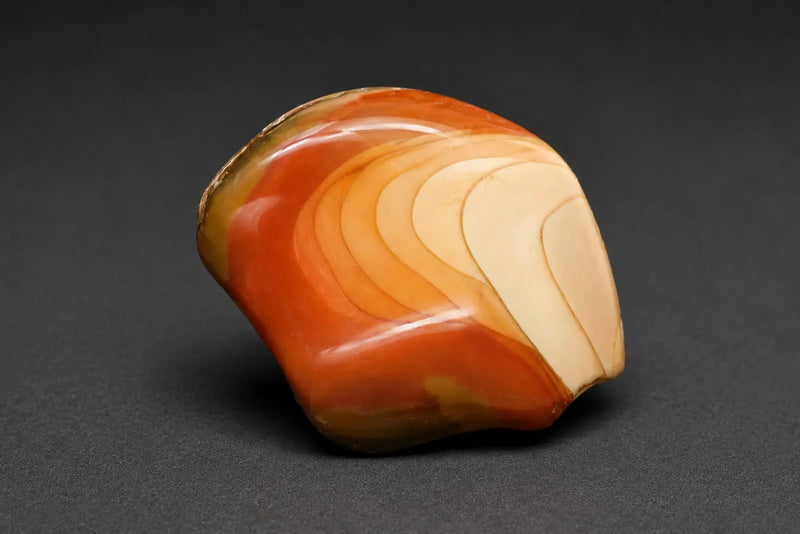
| Bruneau jasper | Bruneau River Canyon area, Idaho | Silica associated with openings in rhyolite; curved, rounded or egg-like patterns are characteristic examples |
The Zuhl Geological Collection at New Mexico State University describes the overlapping oval patterns in a documented Bruneau specimen. These descriptions help explain named material, but a similar pattern in an unlabelled stone does not establish its origin.
If a seller charges a premium for a particular source, ask what supports that identification. A familiar trade name and a scenic photograph are not the same as documented provenance.
Is picture jasper real jasper?
Yes, picture jasper is a real jasper. The name is used for jasper with scenic, layered or image-like patterns after cutting and polishing. The “picture” part does not mean the stone is artificial.
A picture jasper gemstone is a decorative gem used for its color, pattern and polish. It does not have to be transparent or faceted to be used as a gemstone. However, a recognized material name does not authenticate every item offered under that label.
How to identify picture jasper
Look for an opaque body, fine texture and markings that appear to belong to the material. Compare several views under ordinary light rather than relying on one highly edited photograph.
- Look at the pattern. Bands and patches may vary across the piece. An identical surface image repeated on separate beads deserves closer examination.
- Inspect the finish. Clear close-ups can reveal chips, pits, cracks or a coating that is wearing at an edge.
- Ask about treatments. Natural material may still have been dyed, coated or otherwise treated. “Natural” does not automatically mean untreated.
- Check origin claims separately. Pattern alone cannot confirm a mine or locality.
Coolness, weight and earthy color are clues, not conclusive tests. Other stones and glass can share those features. Avoid scratch tests or solvents on a finished piece; for an important purchase, ask a qualified gemologist to assess the material and any detectable treatments.
Is picture jasper rare or valuable?
Picture jasper as a broad material is not extremely rare. Common beads, cabochons and polished stones are widely available. A particular piece can be more desirable because of its scene, condition, workmanship or documented source.
The main value factors are:
- A clear or visually balanced pattern
- Attractive contrast between colors
- A smooth polish without distracting damage
- Size and usable surface area
- Cutting or carving quality
- Credible information about a collectible locality
Compare like with like. The asking price of a large, carefully cut cabochon says little about the value of a small bead or a bag of rough material. There is no single price per carat that reliably describes the whole category, and a retail asking price is not proof of resale value.
What is picture jasper used for?
Picture jasper is used for beads, pendants, cabochons, carvings and decorative objects. A wide polished surface can display a complete scenic pattern; smaller pieces bring fragments of that pattern into a design.
For beaded pieces, look at the finish and overall construction as well as the markings. Even sizing, smooth drill holes and secure stringing matter in everyday use. Natural variation can be part of the appeal without every bead needing to show a recognizable scene.

NATURAL JASPER BEAD BRACELET
How to care for picture jasper
Use warm soapy water and a soft cloth or brush, then dry the stone thoroughly. This follows the gentle stone-cleaning guidance published by Fire Mountain Gems.
For a finished piece, follow the maker's instructions for its cord, metal, adhesives and any treatments. A stone that tolerates brief cleaning does not make the whole item suitable for soaking or swimming. When treatment details are unknown, avoid harsh chemicals and abrasive cleaning.
Store polished pieces so they do not knock against one another or rub against harder stones. Check stringing and fittings periodically; the durability of the stone is only one part of how a finished item wears.
Picture jasper questions
Are the pictures inside the stone natural?
In genuine scenic jasper, the markings are part of the material. Their resemblance to mountains, dunes or clouds is something the viewer recognizes in the pattern. A seller should disclose any coloring or surface treatment.
Is landscape jasper another name for picture jasper?
Landscape jasper is a descriptive name sometimes used for scenic material. Trade names overlap, so check the actual material and source rather than assuming two similar labels describe identical stones.
Can picture jasper get wet?
Brief cleaning with water is generally suitable for the stone. Prolonged immersion is a separate question, especially for treated material or a finished piece with cord and metal components. Follow the maker's care instructions.
What is the rarest type of jasper?
There is no single universally agreed rarest jasper. Names can describe a color, pattern, locality or commercial label. A documented source and the quality of an individual piece are more useful than an unsupported rarity claim.

Save 20%
Coordinated pieces, ready to wear.

Up to 15%
Pick any 3 or 5 bracelets.
From a customer
★★★★★
“Still wearing it two months later.”
Nick Verified · Sicily set


